

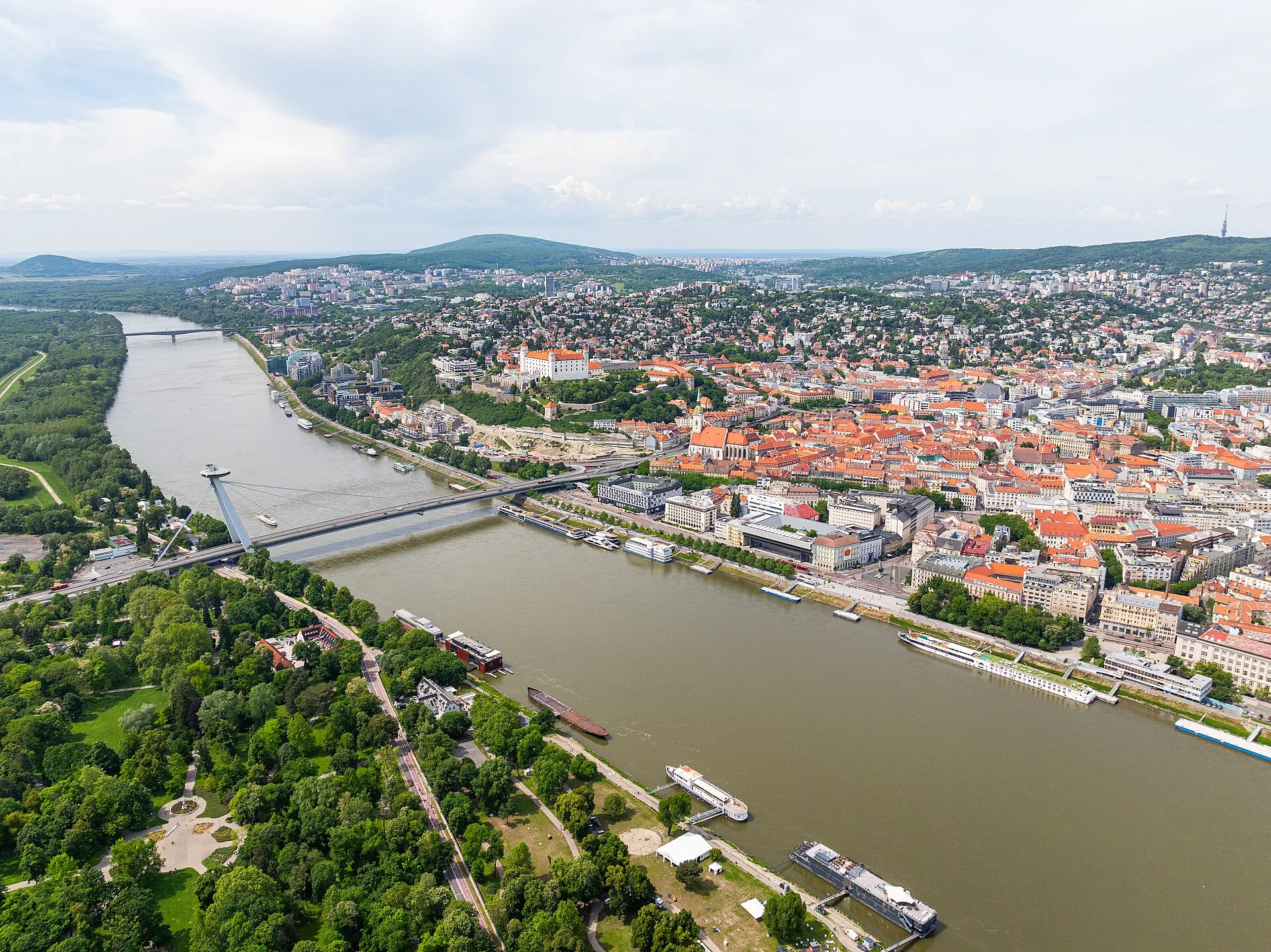
Bratislava becomes interesting the moment you stop asking why it isn't Vienna.
The fastest way to misunderstand Bratislava is to arrive from Vienna.
Not because Vienna is better.
Because Vienna refuses to leave the conversation.
Almost every introduction begins by mentioning that the Austrian capital is nearby. Bratislava is regularly sold as the cheaper day trip, the smaller neighbour or the place you add when Vienna has become too expensive for another night.
Imagine introducing Antwerp only as something to do after Brussels.
It would sound lazy.
Bratislava deserves the same courtesy.
The mistake is not visiting Bratislava after Vienna.
The mistake is continuing to judge it by Vienna once you arrive.
The city suffers from someone else’s success
Vienna is one of Europe’s great capitals.
Bratislava is one of its smaller ones.
That is not a failed version of the same idea.
Vienna overwhelms through scale. Palaces continue for kilometres. Museums become entire days. Public transport quietly stretches the city into something much larger than the centre suggests.
Bratislava works differently.
Within a relatively short walk, you can move from the compact Old Town to the Danube, cross beneath the UFO tower, enter Petržalka and look back at the castle from a city that suddenly appears much less historical and much more ordinary.
The limits remain visible.
That changes the rhythm of the trip.
You spend less time commuting between important things and more time deciding whether another important thing is actually necessary.
Bratislava becomes interesting the moment you stop asking why it is not Vienna.
Small is not incomplete
Many visitors complete Bratislava in a day and conclude there was little to do.
A more accurate observation is that they completed the obvious route.
Those are different things.
The historic centre is genuinely small.
There is no reason to pretend otherwise.
Michael’s Gate leads into a compact network of streets around the Main Square, the Old Town Hall and the Primate’s Palace. The castle remains visible above the roofs. The Danube appears before the city has had time to become exhausting.
That scale can feel underwhelming when the objective is to collect monuments.
It becomes useful when the objective is to spend time somewhere.
Bratislava allows you to see something, stop, change direction and return without turning the day into urban logistics.
A city does not become incomplete merely because it leaves room in the schedule.
There are actual highlights. They simply do not need to dominate the trip.
Bratislava does have recognisable attractions.
They should be linked, visited selectively and then allowed to stop controlling the article.
Bratislava Castle provides the most obvious view over the Danube and Petržalka. The grounds are worth walking even when the museum itself is not the priority.
The Blue Church is small, pale blue and strange enough to justify the short walk from the Old Town. Its opening hours remain connected to religious use, so seeing the exterior is easier than assuming the interior will be permanently available.
The reconstructed Slovak National Gallery is more useful than another generic old-building visit. Its Danube-side complex combines historical structures, twentieth-century architecture and a contemporary renovation without attempting to make them look as though they were always meant to agree.
The Primate’s Palace, St Martin’s Cathedral and Old Town Hall remain available when historical interiors matter.
You do not need all of them.
Bratislava does not punish selective attention.
The castle is not the city
Bratislava Castle dominates almost every photograph.
It should.
Standing above the Danube, it provides the clearest visual introduction to the capital.
Spend time around it.
Then spend more time below it.
The streets between the castle hill, Hviezdoslav Square, the riverfront and the residential edges of the centre explain Bratislava more effectively than another panoramic photograph.
The castle introduces the city.
It does not summarise it.
Below it, Bratislava is less ceremonial: offices, small restaurants, ordinary apartment entrances, tram stops, courtyards and public spaces that do not announce why a visitor should care about them.
That absence of constant explanation is part of the attraction.
Petržalka explains more than another palace
Many visitors cross the SNP Bridge only to reach the UFO observation deck.
That is understandable.
The bridge itself is spectacular. The tower rises 95 metres above the river and gives a 360-degree view over the castle, Old Town, Danube and the much larger residential city beyond.
But continue walking.
Petržalka is one of Central Europe’s largest areas of panel housing. Guidebooks often reduce it to communist apartment blocks because concrete is easier to describe than ordinary life.
Residents call it home.
The district is greener and less oppressive at ground level than the skyline suggests. Paths, trees, schools, sports grounds and residential services sit between the long apartment blocks.
The point is not that every visitor must perform an architectural appreciation of prefabricated housing.
The point is that Bratislava did not stop existing where tourism stopped paying attention.
From the Old Town, Petržalka looks like the opposite bank.
From Petržalka, the postcard city becomes a compact object across the river.
That reversal is worth the walk.
Devín makes sense because it is outside the comparison
Almost every visitor should at least consider Devín Castle.
Not because every guide includes it.
Because it changes the scale of the trip.
The ruins stand above the confluence of the Danube and Morava rivers, on a landscape shaped by borders long before weekend tourism began comparing hotel prices in Vienna and Bratislava.
The city disappears.
Bratislava briefly feels less like a small capital beside a larger one and more like a settlement positioned between rivers, frontiers, empires and modern states.
Devín is accessible by public transport, car and seasonally by boat. Opening hours vary through the year, so the current schedule matters more than a permanent promise in an article.
Do not squeeze it into a rushed afternoon merely because it appears on a list.
Go when the extra half-day improves the trip.
Skip it when it does not.
That principle works throughout Bratislava.
The people are not required to perform the city for you
Bratislava often feels less theatrically welcoming than heavily visited capitals.
That is not the same as unfriendly.
Service can be direct. Conversations may begin neutrally rather than with an immediate performance of enthusiasm. People frequently appear to be using cafés, trams and public spaces for their own lives rather than participating in the visitor economy.
This can feel refreshing.
It can also be misread.
A reserved waiter is not necessarily hostile. A quiet table is not automatically bored. A person who answers the question without expanding it into a conversation may simply believe the question has been answered.
Bratislava’s social atmosphere tends to improve when visitors stop expecting instant intimacy.
Be normal.
Say hello.
Do not treat every neutral face as a customer-service failure.
The city warms gradually, which is consistent with almost everything else it does.
Nightlife exists. It is simply easier to walk past.
Bratislava has nightlife.
It is small, concentrated and inconsistent enough that a single wrong turn can make it appear absent.
The Old Town contains late bars and clubs within a compact area. Good Life Club currently runs from Wednesday to Saturday, with hip-hop, Afrobeat, Latin, pop and commercial party music rather than requiring visitors to prove knowledge of an obscure electronic subgenre.
Channels Club operates close to Michael’s Gate across three floors and advertises itself as open every night of the year from 21:00 until morning.
Neither needs to be described as culturally important.
They are commercial nightlife options in a small capital.
That can be sufficient.
The more useful advice is spatial.
Do not assume the brightest street contains the best evening. A narrow passage, basement entrance or small alley may contain a functioning bar while the obvious frontage beside it is little more than neon and confidence.
Do not follow the lights blindly.
Or follow them.
Sometimes making the slightly wrong decision is the quickest way to understand how small the nightlife district really is.
On Fridays and Saturdays, enough people are out to produce an actual evening. Midweek, choosing a specific venue matters more. The Old Town can remain active without every club becoming convincingly full.
Bratislava is not Berlin, Budapest or Belgrade after dark.
It does not need to pretend otherwise.
The advantage is that a failed venue rarely costs an hour of transport. Leave, walk for five minutes and inspect the next option.
Bratislava is an excellent road-trip stop
The claim that nobody should bring a car to Bratislava needs qualification.
You do not need one for the central city.
Bratislava is, however, extremely useful inside a road trip.
It sits at the meeting point of Slovakia, Austria and Hungary, beside the Danube and close to several landscapes that make more sense as a route than as isolated day trips.
The direct western approach can include Hainburg an der Donau, an Austrian border town positioned between Vienna and Bratislava. Nearby, Carnuntum places a reconstructed Roman quarter, archaeological sites and museum spaces roughly thirty minutes by car from Bratislava.
That corridor gives the Vienna–Bratislava journey an actual middle.
It no longer needs to be airport, motorway, capital.
Further south-west, northern Burgenland and Lake Neusiedl can create a wider loop through flat landscapes, reed beds, small towns and open roads.
Wine exists there.
It does not have to become the organising principle of the route.
A drive can be worthwhile because the landscape changes, because the villages are spaced well and because two capitals begin to look less like rivals once they are placed inside the same border region.
Bratislava also works before continuing deeper into Slovakia, towards Trenčín, the central mountains or the Tatras.
In that context, the city’s manageable size becomes a major advantage.
You can arrive, park, stay centrally, spend an evening and continue without needing to recover from the capital itself.
Do not use the car inside the city unless it is already part of the trip
The historic centre is walkable.
Trams, buses and trolleybuses connect the wider city, while night buses continue after regular daytime services stop.
A vehicle becomes useful when Bratislava is one point in a regional route.
Inside the centre, it mainly becomes a parking problem with mirrors.
The sensible approach is:
- leave the car at the hotel or a proper car park;
- walk the Old Town and river;
- use public transport for Petržalka or more distant neighbourhoods;
- collect the car again for Devín, Hainburg, Carnuntum, Burgenland or the next Slovak destination.
The car should expand the map.
It should not follow you between lunch and the Blue Church.
Stay as long as the city remains useful
There is no obligation to spend exactly one, two or three days in Bratislava.
One full day can work.
You can see the Old Town, castle area, river and one or two specific attractions without moving aggressively.
Two nights allow the city to become more than an itinerary. You gain an evening, a slower morning and the option to cross the river or visit Devín without forcing it.
Three or four nights work when Bratislava is used as a base or road-trip pause rather than as a monument-delivery system.
Stay longer when:
- the pace suits you;
- the trip includes Devín or the Austrian border region;
- you want to work, rest or recover between larger destinations;
- the smaller city feels preferable to another move.
Leave earlier when you are finished.
Bratislava does not require visitors to demonstrate commitment through duration.
The correct amount of time is the amount that keeps the city proportionate.
Who Bratislava is for
Bratislava works for travellers who appreciate manageable cities.
People who enjoy walking instead of commuting.
Visitors who can spend an afternoon on one gallery, one long meal and a river walk without worrying that fifteen major attractions remain uncompleted.
It works particularly well during a road trip, when its location matters as much as its centre.
It suits travellers who enjoy cities where ordinary life remains visible and where people are not constantly employed in proving that the destination deserves attention.
It may disappoint travellers expecting another Vienna.
Fortunately.
Another Vienna already exists.
It is called Vienna.
Bratislava’s success is that the comparison eventually becomes unnecessary.
The city does not need to become grander.
Visitors simply need to stop asking it to become someone else.
