

A city can remember a war without becoming a museum built around it.
Sarajevo makes it very easy for a visitor to feel historically responsible.
The assassination that helped trigger the First World War happened beside the river. The siege remains visible in museums, damaged façades, memorials and the geography of the hills. Hotel descriptions casually mention former front lines. Walking tours offer several hours of atrocity, survival and ammunition marks before lunch.
Then somebody directs you towards Baščaršija for coffee.
This has become the standard package:
war, coffee, Ottoman streets, one bridge and a reassuring conclusion about coexistence.
It is not entirely false.
It is simply much too small for the city.
Sarajevo remembers the war because the people who live there do not have the luxury of pretending it happened elsewhere. Visitors should take that history seriously.
They should also notice that the tram keeps moving, offices open, football arguments continue, people occupy cafés for reasons unrelated to cultural symbolism and entire neighbourhoods exist beyond the part of the valley most travel guides repeatedly photograph.
Sarajevo is not a war museum with cafés attached.
It is a capital that contains museums, cafés, hills, administrative confusion, direct service, long lunches, difficult winters and a great deal of ordinary life.
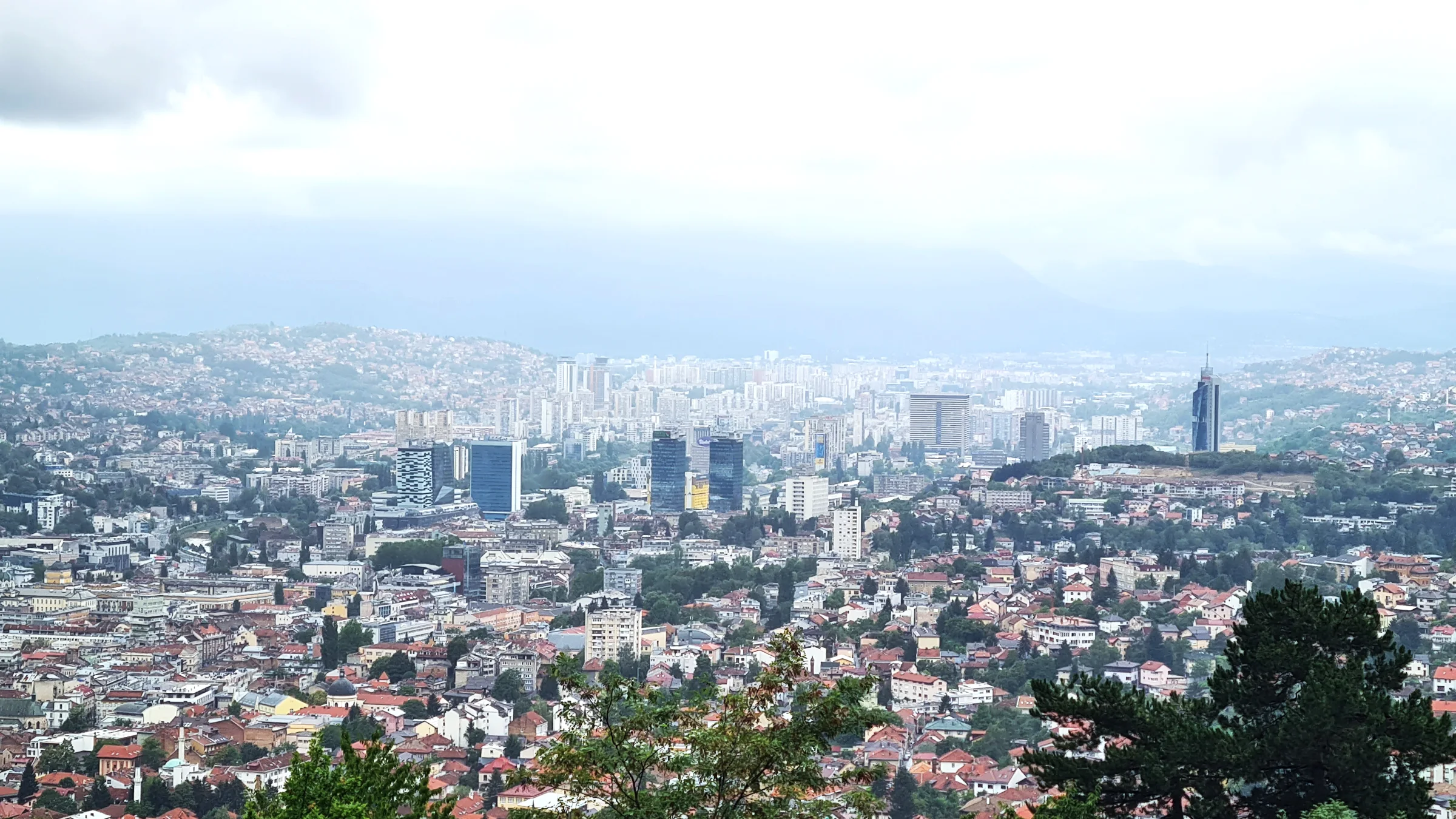
The city is a line with hills attached
Sarajevo becomes easier to understand once you stop imagining it as a circular old European centre.
The city is stretched through a narrow valley along the Miljacka River.
At the eastern end sits Baščaršija, followed by the pedestrian streets around Ferhadija, the administrative and commercial centre, Marijin Dvor, Grbavica and the broader residential city continuing west towards Ilidža.
The surrounding neighbourhoods rise quickly into the hills.
That geography shaped the siege.
It also shapes a normal Tuesday.
Distances that look short on the map can involve a steep climb. A hotel with a panoramic view may require a taxi every time the novelty of the slope disappears. Streets that appear parallel can sit at noticeably different elevations.
The valley floor is the practical city.
The hills provide views, housing, cemeteries, older mahalas and several routes that are pleasant while descending and less philosophical on the way back up.
Choose accommodation with the gradient in mind.
“Ten minutes from Baščaršija” can describe both an easy walk and a daily cardiovascular programme.
Baščaršija is still working. It also knows you are coming.
Baščaršija is not a preserved Ottoman film set.
Craft workshops, mosques, bakeries, grill restaurants and small shops continue to operate inside it. People buy practical things. Deliveries arrive. Residents cut through the streets without admiring them.
It is also Sarajevo’s most obvious visitor district.
Souvenir displays, tour groups and restaurants with multilingual menus are not external contamination. They are now part of how the district earns money.
The useful response is not to search theatrically for the one alley no tourist has discovered.
Visit at different times.
Early morning shows shutters opening, bread arriving and the commercial district assembling itself. The middle of the day belongs more heavily to visitors. Evening changes the balance again as day-trippers disappear and the cafés become more social than operational.
The central square around Sebilj is an orientation point, not a complete experience.
Continue into Kazandžiluk, Bravadžiluk and the streets around the Gazi Husrev-beg Mosque.
Stop when somewhere looks useful.
You do not need to purchase a copper coffee set to prove the walk happened.
Eat without turning every meal into a heritage demonstration
Sarajevo food is inexpensive enough that travel writing often becomes excitable about quantity.
That is not the most useful way to eat.
Start with ćevapi because they are good, quick and specific to the city—not because a list declares them mandatory.
At Bulevar Ćevabdžinica, a current large portion of ten ćevapi costs 13 BAM (€6.65). A smaller five-piece portion is 8 BAM (€4.09).
Those are concrete prices from one current menu, not a promise that every grill in Sarajevo charges the same.
Several of the most established ćevabdžinicas sit close together in Baščaršija. The differences between them matter greatly to people who already have a favourite and much less to a hungry visitor eating the first good portion.
Try an aščinica as well.
Aščinica ASDŽ serves a much wider range of cooked Bosnian dishes than the usual grill-only introduction: stuffed vegetables, stews, veal, soups and daily dishes that are closer to lunch than street food.
This matters because Sarajevo cuisine does not begin and end with minced meat.
Burek and the other filled pies work for breakfast, lunch, travel days and moments when a proper restaurant would require more decision-making than the situation deserves.
Use bakeries that are busy.
Fresh turnover is a more useful quality signal than a paragraph about grandmother’s recipes written by a marketing department.
Coffee is social time, not a municipal performance
Bosnian coffee matters in Sarajevo.
It does not need to carry the entire identity of the city.
At Dibek in Baščaršija, coffee is served in the expected traditional setting, alongside tea and hookah. The venue stays open daily until midnight and is deliberately atmospheric.
That can be enjoyable.
It is also a business built around providing the version of Bosnian coffee many visitors imagine before arriving.
Elsewhere, Sarajevo residents drink espresso, macchiato, cappuccino, Bosnian coffee and whatever else suits the table.
A current polished Sarajevo menu at Del Gusto lists espresso at 3 BAM (€1.53) and Bosnian coffee at 5.50 BAM (€2.81). The setting and location differ from a traditional kafana, but the comparison is useful: “local coffee” is not one fixed product at one fixed price.
The important part is duration.
Coffee can occupy a table considerably longer than the liquid requires. Conversation is allowed to outlive the order. Nobody seems especially concerned that the table might have achieved higher hourly revenue.
Visitors often interpret this as ritual.
It may simply be people sitting with people they know.
Order the coffee.
Do not narrate yourself drinking it.
Stop using one paving line to explain an entire city
On Ferhadija, a marker known as Sarajevo Meeting of Cultures indicates the visible shift between the Ottoman-era commercial streets and the more formal Austro-Hungarian centre.
Stand there and look in both directions.
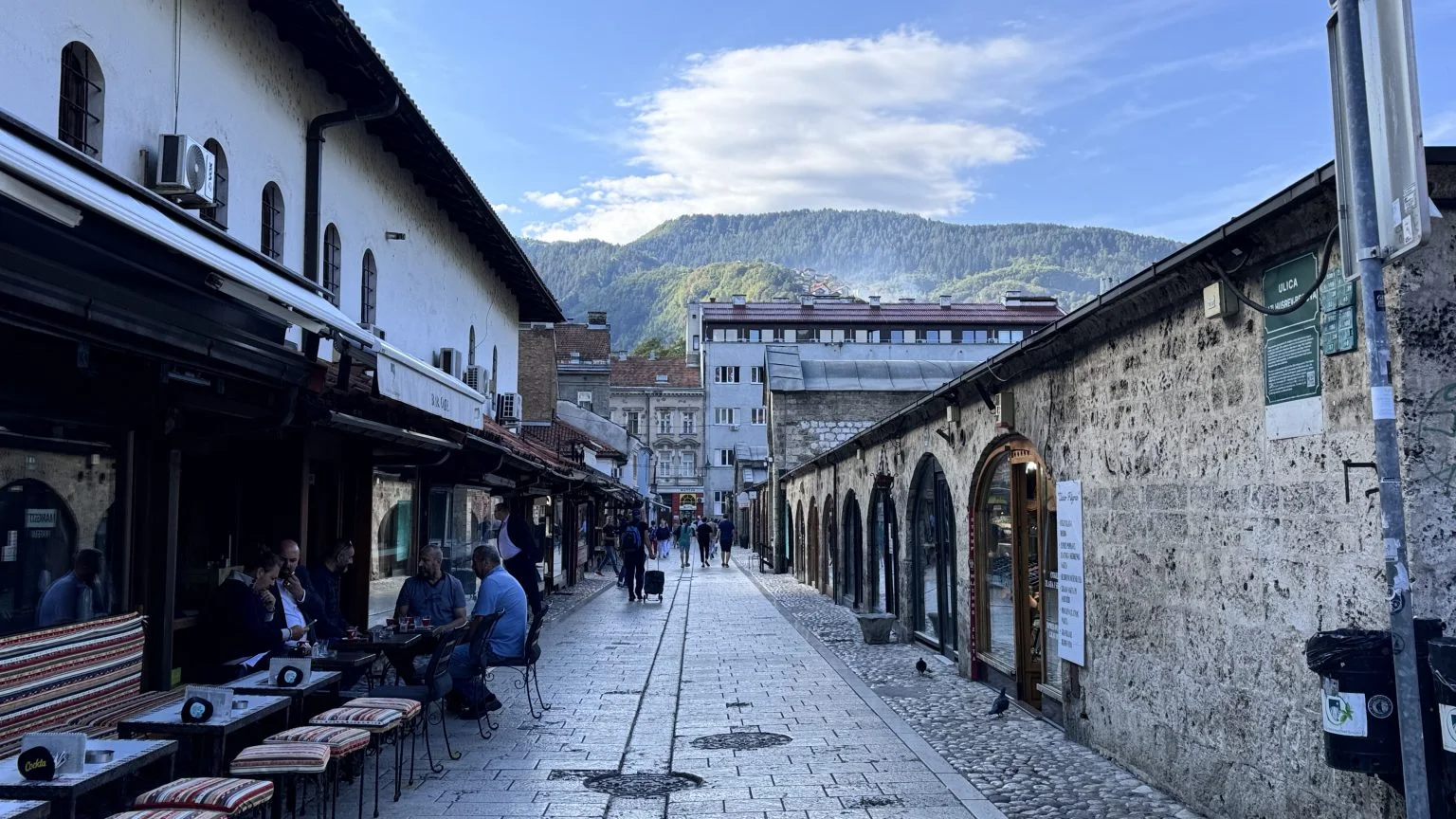
The architectural change is real.
The standard conclusion—“East meets West”—is considerably less useful.
Sarajevo is not a harmonious architectural demonstration prepared to explain civilisation in two camera angles. The Ottoman, Austro-Hungarian, Yugoslav and post-war layers were produced through changes of power, administration, population and economy.
They did not meet politely for tourism.
Continue west through the pedestrian centre towards the Eternal Flame, then into the streets around Marijin Dvor.
The city becomes less picturesque and more complete.
That is not a decline in quality.
It is the point at which Sarajevo stops summarising itself.
The assassination site needs about fifteen minutes
The Latin Bridge is historically important.
The assassination of Archduke Franz Ferdinand and Sophie took place nearby on 28 June 1914. The event became one of the immediate triggers of the First World War.
The bridge itself remains a modest stone bridge across a modest river.
That mismatch is instructive.
Large historical consequences do not require large architecture.
The small Museum of Sarajevo 1878–1918 stands beside the assassination site. Admission is 5 BAM (€2.56), while a combined ticket for all five Sarajevo Museum annexes costs 20 BAM (€10.23).
Visit when the subject interests you.
Do not expect the bridge to generate an emotional response simply because history textbooks assign it one.
Take the photograph.
Read the context.
Continue walking.
Do not turn one day into a sequence of suffering
Sarajevo has several institutions dealing with war, occupation, memory and interrupted lives.
The correct response is selection.
The War Childhood Museum is the strongest first recommendation. Personal objects and short testimonies explain childhood during war without converting children into anonymous evidence.
It is specific, carefully edited and emotionally demanding without becoming theatrical.
The History Museum of Bosnia and Herzegovina offers a broader and more institutional perspective. It is open daily from 09:00 to 19:00, with adult admission at 10 BAM (€5.11).
The building and exhibition style are less polished than many contemporary visitor attractions.
That is not automatically a weakness.
The National Museum of Bosnia and Herzegovina covers archaeology, ethnology and natural history rather than existing only to explain the 1990s. Adult foreign admission is 20 BAM (€10.23).
The museum also houses the Sarajevo Haggadah, shown during specific hours and under controlled conditions.
That institution is important precisely because it expands the historical timescale.
Sarajevo existed before the siege.
Bosnia existed before Yugoslavia collapsed.
A serious visit should make that visible.
Choose one major memory-focused museum per day.
You are not improving your moral character by becoming emotionally numb before dinner.
The Tunnel of Hope requires a journey and a decision
The Tunnel of Hope sits near the airport in Butmir, away from the walkable central museum cluster.
During the siege, the tunnel connected the surrounded city with territory beyond the airport zone and became essential for moving people, supplies and equipment.
The surviving site includes the original entrance and sections representing the tunnel’s construction and use.
Regular admission is 20 BAM (€10.23). Student admission is 8 BAM (€4.09), and the audio guide costs 3 BAM (€1.53). The museum states that it does not accept cards or foreign currency.
Bring convertible marks.
The location changes the practical calculation.
The tunnel is not something to add because an afternoon appears empty. Reaching it requires transport and enough time to understand what the site is explaining.
Go when siege history is a central reason for the visit.
Do not force it into a two-day city break already containing three other war museums.
The siege makes more sense once you look at the terrain
Sarajevo’s hills are visually attractive.
During the siege, they also created the conditions for encirclement and fire into the valley.
That geography becomes clear from Yellow Fortress, Vratnik and the higher streets above Baščaršija.
The view helps explain vulnerability.
It should not turn every overlook into a war observation deck.
People live in those neighbourhoods. Children walk home. Laundry hangs on balconies. Cars attempt corners built before cars became this large.
Walk up for the view.
Notice the slope, density and narrow streets.
Then allow the area to return to being residential.
The easiest mistake in Sarajevo is to interpret every piece of geography through violence because violence is the history the visitor recognises most quickly.
Trebević is allowed to be recreational again
Mount Trebević rises directly above the city and can be reached using the Trebević Cable Car.
The cable car currently operates from 12:00 to 21:00 on Mondays and from 09:00 to 21:00 on other days, although seasonal and operational changes remain possible.
The published tourist fare is 15 BAM (€7.67) one way or 20 BAM (€10.23) return.
The ride is short.
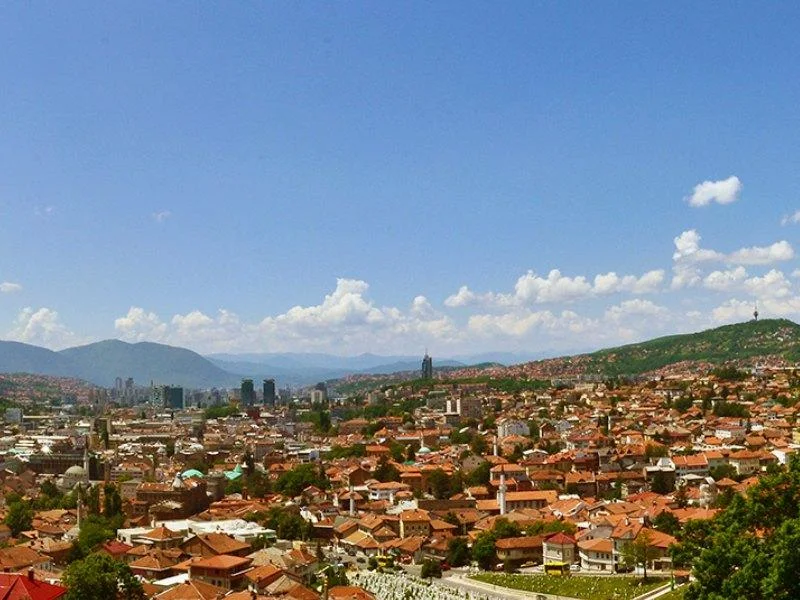
The change in altitude is the value.
Within minutes, the traffic and dense valley become a view rather than an environment. Paths, trees and recreational facilities occupy the mountain. The abandoned Olympic bobsleigh track is reachable from the upper area and remains popular with visitors.
It is not the only reason to go.
The 1984 Winter Olympics matter to Sarajevo’s history, as does the damage and later use of Olympic infrastructure during the war. But Trebević is also where residents walk, cycle, eat, escape heat and occasionally escape the winter air trapped below.
The mountain does not need to remain ruined to remain meaningful.
Marijin Dvor is where the timeline becomes less convenient
Marijin Dvor lies west of the historic pedestrian centre.
This is where administrative buildings, shopping centres, hotels, museums, traffic and Yugoslav-era urban planning begin to dominate the view.
The National Museum and History Museum sit close together. The former Holiday Inn remains visually associated with international journalists during the siege, although it functions now as a contemporary hotel rather than a historical exhibit.
Continue west and Sarajevo becomes increasingly residential.
The tram becomes more useful. The riverbank opens. The city stops supplying a major historical fact every fifty metres.
This is where a longer stay begins to feel different from a short one.
The centre contains Sarajevo’s most visible identity.
Marijin Dvor and the districts beyond contain more of its current scale.
Grbavica should not be visited only because a film used its name
Grbavica sits south of the river and west of the central visitor area.
It was directly affected by the war and division of the city. It is also now a normal, active neighbourhood with apartment blocks, shops, cafés, schools and the football stadium of FK Željezničar.
That combination is exactly why it belongs in the guide.
Do not go searching for visible damage as though the neighbourhood owes visitors evidence.
Go because the walk or tram journey reveals how Sarajevo functions beyond Baščaršija.
Have coffee.
Watch traffic.
Notice the difference between streets designed around ceremonial history and streets designed around housing thousands of people.
An ordinary neighbourhood does not need to become an attraction to improve your understanding of a city.
The people are warmer than the service sometimes sounds
Sarajevo hospitality is frequently described in extravagant terms.
The actual experience can be more direct.
A waiter may appear uninterested until a conversation unexpectedly develops. A receptionist may give exactly the information requested and none of the emotional reassurance expected around it. A shopkeeper can move quickly from neutral to genuinely helpful without inserting a customer-service performance between the two.
Do not confuse reserve, fatigue or efficiency with hostility.
Do not assume every brusque interaction contains a political message about your nationality.
People in Sarajevo are not employed collectively to demonstrate the city’s famous warmth.
Normal behaviour works well:
say hello, ask clearly, be patient and do not demand instant intimacy.
When connection happens, it often feels less manufactured precisely because nobody promised it at the door.
Evenings do not require a cultural excuse
Sarajevo has bars, restaurants, clubs, shopping streets and late social life.
This general destination guide does not need to turn that into a venue inventory. A dedicated after-dark guide should handle current addresses, programmes and the difference between a Thursday crowd and an open door.
For now, understand the geography.
Baščaršija remains social after the daytime shops begin closing. Ferhadija and the central streets provide an easy first evening. Skenderija, Marijin Dvor and other parts of the central valley offer bars and clubs outside the old-town setting.
A night out does not need to involve traditional music, a historic interior or a lecture about Sarajevo identity.
Commercial pop music is allowed.
So is one ordinary drink.
Sarajevo has already carried enough symbolic responsibility without requiring every Saturday night to represent coexistence.
Public transport is simple in shape and untidy in detail
The tram follows the valley and provides the clearest backbone through the city.
Trolleybuses, buses and minibuses extend the network into other neighbourhoods and hills. The system is inexpensive, but ticket formats, operators and sales points can be less intuitive than the route map suggests.
Buy a ticket for the actual service you are using.
Validate paper tickets when required.
Do not assume a tram ticket automatically functions on every bus merely because both vehicles belong to public transport.
Live routing information has improved, but stop displays and online instructions remain inconsistent. Ask locally when a connection matters.
For Baščaršija, Ferhadija and much of the centre, walking is easier.
Use the tram once the city begins stretching west.
Use taxis or booked rides for steep accommodation, the Tunnel of Hope and late journeys that no longer look sensible on foot.
Keep cash without behaving as though cards do not exist
The convertible mark is fixed against the euro at 1 EUR = 1.95583 BAM.
For rough mental arithmetic, divide the BAM amount by two.
Cards are accepted increasingly widely in hotels, larger restaurants, museums and shops. They are not universal.
Small food businesses, cafés, transport purchases and the Tunnel of Hope may require cash.
Carry BAM rather than expecting businesses to accept euros.
The fixed exchange rate makes conversion straightforward. It does not make foreign currency legal tender at every counter.
Winter air can ruin the romantic valley
Sarajevo’s surrounding hills create the city’s shape and many of its best views.
In winter, the same basin can trap polluted air beneath temperature inversions.
Fog becomes smog. Visibility drops. Breathing can become uncomfortable or unhealthy, particularly for children, older travellers and people with respiratory conditions.
This is not a minor seasonal inconvenience.
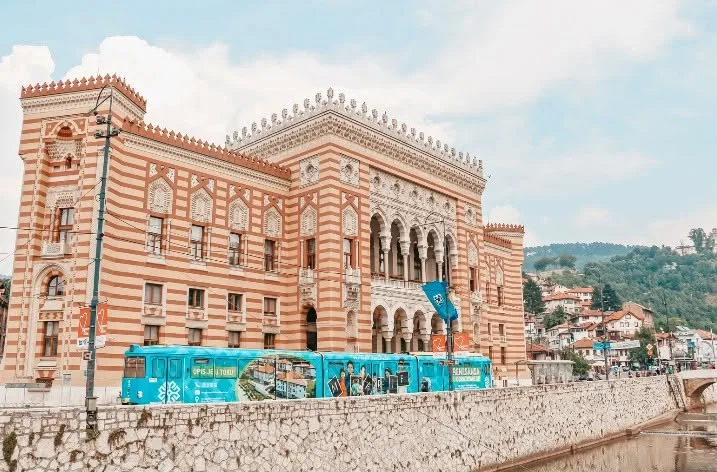
Check current air-quality readings before and during a winter visit. Adjust outdoor plans when pollution becomes severe. Trebević and the surrounding mountains may sit above the trapped air, but a cable-car excursion does not remove the exposure involved in sleeping and walking below.
Snowy Sarajevo can be beautiful.
So can not coughing.
Late spring and early autumn usually provide an easier balance of walking weather, clear views and functional outdoor space.
Safety is mostly ordinary. The mine warnings are not.
Central Sarajevo is generally straightforward to visit.
The most likely urban problem is petty theft in crowded tourist areas rather than serious violence. Watch bags around Baščaršija, public transport and busy events.
The unusual safety issue appears outside normal urban routes.
Landmines and unexploded ordnance remain present in parts of Bosnia and Herzegovina. Established roads, marked paths, central neighbourhoods and recognised recreation areas are the sensible places to remain.
Do not improvise hikes through abandoned terrain because a ruined structure appears interesting from the road.
The warning is not theoretical.
Follow marked routes in the hills and mountains.
Sarajevo is a city where wandering is useful.
The wider countryside is not always the place to prove it.
Where to stay
Baščaršija and the eastern old centre
Stay here for immediate access to the historic streets, food and early-morning atmosphere.
Expect more visitor activity, occasional noise, smaller rooms and steep streets depending on the exact address.
Check the gradient and vehicle access.
A beautiful Ottoman-style guesthouse loses some charm when every suitcase must be carried uphill across stone.
Ferhadija and the central pedestrian zone
This is the easiest first-visit location.
Baščaršija, the river, museums and Marijin Dvor remain accessible. Restaurants and cafés are plentiful, while the city still feels active after the sightseeing day ends.
Street-facing rooms can be noisy.
Centrality is not a soundproofing material.
Marijin Dvor
Choose Marijin Dvor for modern hotels, shopping, museums, tram access and a more operational city base.
The old centre remains reachable on foot or by tram.
The immediate surroundings are less atmospheric and more useful.
That is often a good trade.
Grbavica
Grbavica works for longer stays, apartments and travellers who prefer a residential base.
It is less convenient for repeatedly returning to Baščaršija on foot, but the district provides food, cafés and daily services without depending heavily on visitors.
Stay here because you want to live beside Sarajevo for several days, not because a guide has declared it authentic.
How long Sarajevo needs
Two full days can cover the obvious city.
One day can follow Baščaršija, Ferhadija, the river and one museum. The second can add Marijin Dvor, another institution and Trebević or a hillside walk.
Three or four nights produce the better trip.
That extra time allows the visitor to separate the museums rather than stacking them, spend an evening without a checklist and see the city beyond its eastern historic core.
The Tunnel of Hope requires part of a separate day.
Trebević deserves time when the weather is clear.
The National Museum is not improved by being squeezed between two siege exhibitions.
Stay longer when Sarajevo’s pace suits you or when the city becomes a base for a wider Bosnia and Herzegovina journey.
Leave when you are finished.
The city does not need another visitor measuring commitment by exhaustion.
Who Sarajevo is for
Sarajevo works for travellers who can tolerate historical complexity without demanding a clean conclusion.
It suits people interested in cities shaped visibly by geography, empire, socialism, war and imperfect reconstruction.
It works for travellers who enjoy long meals, direct conversations, trams, hills and places where the contemporary city remains close to the historical one without becoming subordinate to it.
It is less comfortable for visitors seeking frictionless transport, uniformly polished service, consistently smoke-free interiors or a city whose major history can be absorbed without emotional effort.
Sarajevo can be exhausting when approached as an obligation.
It becomes considerably more rewarding once the visitor permits it to be ordinary.
The city remembers. It also continues.
Sarajevo should not be asked to move beyond the war for the comfort of visitors.
Nor should it be frozen inside the war because that is the version outsiders recognise most easily.
The museums matter.
The tunnel matters.
The damaged buildings, cemeteries and memorials matter.
So do apartment blocks, coffee after work, football, shopping centres, restaurant arguments, bad winter air, direct waiters and the tram carrying people home through the valley.
A city can remember a war without becoming a museum built around it.
Sarajevo does.
The visitor’s job is to notice both parts.

