

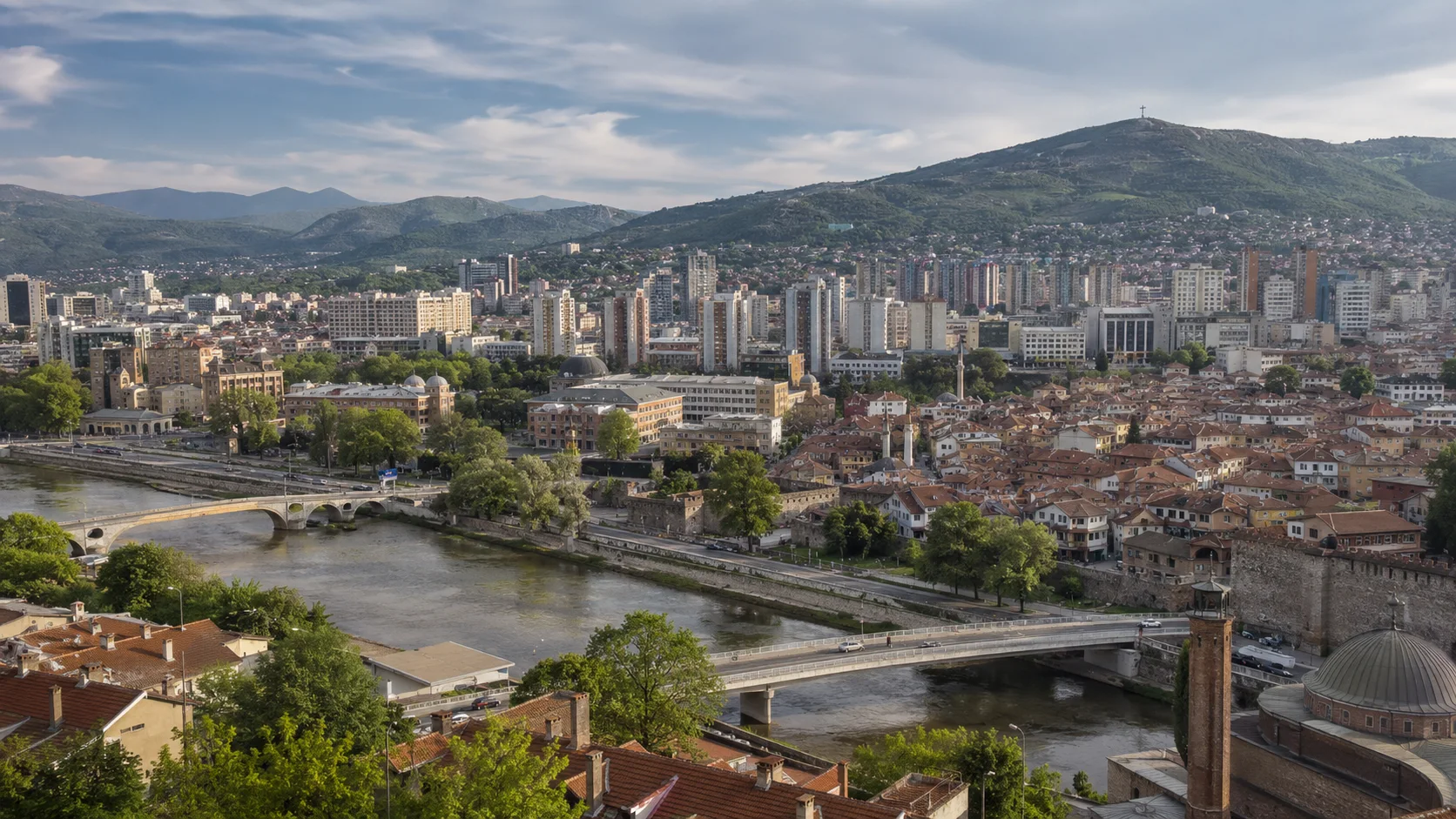
Skopje is not convincing because its centre looks authentic. It is convincing because the city keeps functioning beneath the arguments built on top of it.
The first useful reaction to Macedonia Square is probably disbelief.
A giant horseman rises above fountains programmed for spectacle. Classical columns appear on buildings considerably younger than the people photographing them. Statues occupy bridges, pavements, rooftops and several spaces where another city might have decided that one statue was enough. A triumphal arch closes part of the view. Across the river, domes and pale façades seem to have arrived from an architectural catalogue with the historical context removed.
It looks fake.
That is not an unfair or culturally insensitive first impression.
Much of central Skopje really is recent construction designed to resemble something older, grander and more nationally conclusive. The strange part is not that visitors notice. The strange part is how quickly conventional guides attempt to rescue the city from the observation.
They call it eclectic.
They praise the contrast.
They photograph the fountain at night and move on.
Skopje becomes much more interesting when nobody tries to defend it.
The centre is not a failed attempt at authenticity. It is a political project made physical, built on top of a city that had already been forced to reinvent itself after catastrophe. The fake façades, surviving modernism, Ottoman bazaar, socialist housing, busy restaurants and ordinary streets are not separate attractions.
They are competing answers to the same question:
What should Skopje look like now?
The centre is not pretending by accident
The reconstruction commonly known as Skopje 2014 reshaped the centre during the 2010s through new government buildings, façades, bridges, fountains and an extraordinary population of monuments.
The project was not modest.
The investigative database Skopje 2014 Uncovered, produced by the Balkan Investigative Reporting Network, traced roughly €683 million in publicly funded contracts connected to the transformation.
Buildings accounted for more than €429 million in the database. The remaining expenditure spread across façades, monuments, squares, bridges, garages, fountains and other structures.
That number matters because Skopje 2014 is often consumed as visual comedy.
The jokes are easy. The horse is enormous. Several statues appear to be competing for the same historical importance. Some façades feel less like buildings than stage scenery installed before an opening night that never formally ended.
But expensive absurdity is still politics.
The project attempted to give the capital a monumental national image at a time when questions of identity, history and even the country’s internationally recognised name remained politically charged. It did so by building a version of permanence very quickly.
That contradiction is visible everywhere.
Stone is imitated. History is accelerated. Architecture intended to suggest centuries can still look as though the protective wrapping was removed last Thursday.
Do not spend your first hour trying to decide whether Macedonia Square is beautiful.
Ask what kind of insecurity requires this much certainty.
The city had already been forced to invent itself once
The monumental centre becomes easier to read after visiting the old railway station.
At 05:17 on 26 July 1963, an earthquake devastated Skopje. More than a thousand people were killed, thousands were injured and much of the city was destroyed.
The clock on the damaged station stopped at that moment.
It still displays 05:17.
Only part of the original building survived. Since 1970, its preserved section has housed the Museum of the City of Skopje.
This is the most useful place to begin understanding the city—not because the museum resolves every historical question, but because the building itself explains why Skopje contains so many incompatible futures.
After the earthquake, reconstruction became an international undertaking coordinated with significant United Nations involvement. Architects and planners from different countries contributed to a new city plan. The Japanese architect Kenzo Tange produced the best-known proposal, organised around the ideas of a City Gate and City Wall.
The result was not one perfectly completed master plan.
It was a modern city built through international aid, Yugoslav planning, urgent housing needs, ambitious infrastructure and compromises that accumulated as construction progressed.
Skopje became known as the City of International Solidarity.
That title was not invented for tourism. Countries from both sides of the Cold War contributed assistance, buildings, expertise and resources. Streets, hospitals, schools and neighbourhoods still carry traces of that support.
This history changes the meaning of the centre.
Skopje 2014 did not overwrite an untouched old European city. It overwrote parts of a post-earthquake modernist reconstruction that had itself replaced a heavily damaged earlier city.
The argument was already layered before the columns arrived.
The future arrived in concrete and was never fully unpacked
Skopje’s modernist buildings are often presented as the respectable alternative to the fake classical centre.
That can become another cliché.
Not every concrete building is a masterpiece. Not every visitor needs to make a pilgrimage to an exposed ventilation shaft. Calling something Brutalist does not automatically make the experience of using it pleasant.
Still, the post-earthquake city deserves to be understood as infrastructure rather than merely photographed as architectural evidence.
The railway and bus complex, residential blocks, public buildings, riverbanks and broad roads were part of an attempt to create a functioning modern capital after enormous destruction.
Some elements of that future remain impressively forceful.
Others feel worn, fragmented or cut off by traffic. Pedestrian routes can shift abruptly from generous public space to inconvenient junctions. Buildings designed as pieces of a larger urban system sometimes stand beside later interventions that ignore the system entirely.
That is where Skopje becomes more than an architectural contrast.
The city does not contain one authentic layer and one false layer.
It contains successive projects that never completely agreed to leave.
A monumental façade may cover a modernist structure. A surviving socialist block faces a newly classical government building. A contemporary café operates inside architecture designed for a different economy. A square built for national ceremony opens directly onto a shopping centre that residents once defended against plans to give it the same ornamental treatment.
Skopje is not an architectural mixture.
It is a disagreement with pavements.
The Stone Bridge holds two cities in an awkward conversation
Cross the Stone Bridge from Macedonia Square and the city changes almost immediately.
The statues do not disappear. Nor does the political symbolism. But the scale becomes smaller, the streets narrower and the economic purpose more obvious.
This is the entrance to the Old Bazaar, stretching towards Bit Pazar beneath the fortress.
Travel writing often presents the bridge as a clean line between “new” and “old” Skopje.
It is not that simple.
Both sides have been rebuilt, damaged, redesigned and politically interpreted. The bazaar itself survived earthquakes, wars, socialist redevelopment and changes in trade. It is not an untouched Ottoman district preserved outside time.
What distinguishes it from Macedonia Square is not purity.
It is continued use.
People still buy jewellery, textiles, household goods and food. Workshops remain mixed with cafés, mosques, museums, restaurants and shops that now address visitors. Delivery vehicles enter streets that look pedestrian until they suddenly are not. Some sections are restored enough to resemble heritage presentation. Others remain commercial in the less photogenic sense of the word.
That friction is useful.
Do not visit the bazaar merely as proof that the “real Skopje” exists somewhere behind the fake one.
Both are real.
One simply had longer to weather.
Use the bazaar before turning it into scenery
The Old Bazaar works better when visited while it is still functioning as a market district.
Arrive before the late afternoon drift turns every decision into tea, dinner or photography. Walk beyond the first polished lanes. Continue towards Bit Pazar. Notice where souvenir displays give way to ordinary trade and where the crowd changes without the architecture announcing that a boundary has been crossed.
The bazaar also contains several historical buildings that remain useful rather than merely decorative.
Daut Pasha Hamam was built in the second half of the fifteenth century. The former bathhouse was adapted into an art gallery in 1948 and now forms part of the National Gallery.
Its permanent collection traces Macedonian art from medieval icons through twentieth-century work.
This is a better use of historical architecture than leaving it empty and calling the emptiness atmospheric.
Nearby, Chifte Hamam provides another gallery space inside a former bathhouse. Suli An, Kurshumli An and the surviving religious buildings add further layers, but there is no prize for collecting every caravanserai before lunch.
The bazaar is not improved by treating it as a checklist.
Stop when you find a place that appears busy for reasons unrelated to your arrival.
Order something.
Watch what happens when the tour groups leave.
Debar Maalo is where Skopje stops explaining itself
West of the centre, Debar Maalo offers a different use of the city.
This is often described as Skopje’s bohemian quarter.
Ignore that phrase.
It promises berets that are not coming and usually leads directly to an unnecessary jazz recommendation.
Debar Maalo is more useful as a low-rise neighbourhood where restaurants, kafanas and terraces occupy streets that feel less ceremonial than the centre. Residents come here to eat, drink, meet groups and remain at the table considerably longer than the meal requires.
It is not undiscovered. It is not quiet. It is not always elegant.
That is why it works.
At Kafana Debar Maalo, the menu checked in July 2026 listed tavče gravče, the baked-bean dish closely associated with Macedonian cooking, at 170 MKD. Fresh pork ribs were 300 MKD, homemade sausage 330–350 MKD and village meat 600 MKD.
Those prices are examples from one current menu, not a universal promise about eating in Skopje.
They do show that a proper local meal can remain inexpensive without requiring a search for a fictional restaurant known only to one elderly taxi driver and several travel bloggers.
Debar Maalo works best when dinner itself is allowed to become the evening.
Choose a restaurant that looks active. Check what the nearby tables are ordering. Accept that the room may grow louder. Do not expect the service rhythm to recognise your private intention to visit three more places afterwards.
Skopje is not responsible for your spreadsheet.
Cheap does not mean entirely frictionless
Skopje remains an affordable European capital, particularly for food, taxis and many centrally located stays.
That does not make every part of the trip effortless.
The central area is compact enough to cover on foot, but the experience is not consistently pedestrian-friendly. Major roads, broad junctions and disconnected surfaces can make a short map distance feel more awkward than expected.
Macedonia Square, the Stone Bridge and the first part of the bazaar sit close together. Debar Maalo is still walkable from the centre. Other modernist landmarks and residential districts become easier with a licensed taxi or public transport.
Do not rent a car merely to move around central Skopje.
You will pay to store a vehicle in a city whose most interesting contradictions are best encountered on foot.
A car becomes more relevant when Skopje forms part of a wider North Macedonian route. Even then, collecting it when leaving the central city is usually more sensible than keeping it parked throughout the stay.
Where to stay depends on which version you want outside the door
Staying close to Macedonia Square gives the simplest first visit.
The Stone Bridge, Old Bazaar, central museums and many restaurants are within easy reach. It is also the part of Skopje most committed to performing an official version of itself.
That can be convenient.
It can also make the city seem more theatrical than it really is.
Debar Maalo is stronger when dinners and relaxed evenings matter more than being directly beside the central monuments. The walk into the centre is manageable, while the immediate streets feel more residential and socially used.
The edge of the Old Bazaar offers atmosphere and direct access to the historic district, but choose the exact street rather than relying on the neighbourhood name. Conditions, noise and late-evening activity can change quickly between nearby lanes.
Skopje is compact enough that the correct hotel district is not a major strategic decision.
The correct building may be.
Check recent room photographs, air conditioning, noise comments and the entrance itself. A dramatic view of the fortress does not compensate for discovering that the bathroom belongs to a different stage of urban reconstruction.
