Tirana works best when you stop trying to finish it and start learning how to use it.
You can learn a great deal about Tirana by sitting still.
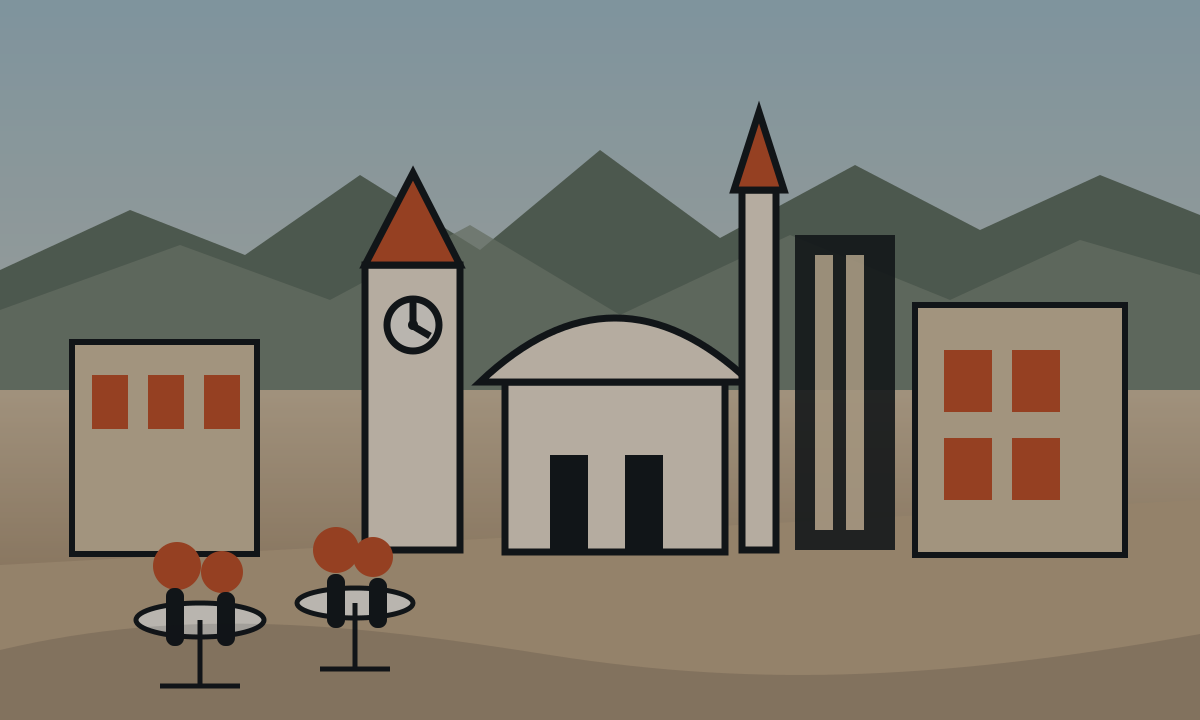
Choose a café in the centre, order the drink that everybody else appears to be ordering and wait. The table will probably remain occupied much longer than the drink requires. People arrive well dressed, settle in, look around and allow themselves to be looked at. There may be music, traffic, conversation and an impressive number of coffee cups, but surprisingly little physical movement.
This is not inactivity.
It is Tirana happening in public.
That distinction matters because Tirana is often described through the wrong travel vocabulary. It is called colourful, youthful, energetic, affordable and rapidly changing. All of that can be true, but none of it explains how to use the city once you are there.
Tirana is not a compact old town waiting to be completed street by street. It is not a sequence of monumental sights with a convenient lunch between them. It is a capital where cafés function as public living rooms, an evening can matter more than an afternoon attraction, hotel standards can jump several decades between the lobby and the reception desk, and a remarkably cheap rental car can make the places outside the city more relevant than another hour inside it.
Tirana works best when you stop trying to finish it.

Start with the café, not the square
Most visitors begin at Skanderbeg Square, which is reasonable. It is central, pedestrianised and surrounded by buildings that compress several versions of Albania into one view.
The square is useful for orientation. It is less useful as an explanation.
Tirana begins to make more sense in the cafés around it, along pedestrian streets, around Pazari i Ri and especially further south towards Blloku. Coffee is not merely something people consume between activities. It often appears to be the activity itself.
At an ordinary central bar, coffee can still be almost implausibly inexpensive. The online menu at Bar Colosseum lists an espresso at 90 ALL (about €0.96), a macchiato at 100 ALL (about €1.07) and a cappuccino at 160 ALL (about €1.71). At a more styled venue such as Komiteti, delivery listings show a macchiato or cappuccino at 250 ALL (about €2.67).
The euro equivalents in this guide use the Bank of Albania’s official reference rate for 24 July 2026—€1 = 93.72 ALL—and are rounded for orientation. Your card, bank or exchange office may use a different rate.
Those are not universal Tirana prices. They are examples from different types of venue, checked in July 2026. They do, however, help explain why a table can remain occupied without anybody appearing anxious to conclude the transaction.
A coffee is cheap enough to be a social permit.
The surprising part is how dominant it remains. Late in the day, and sometimes well into the evening, tables still fill with small cups. Albania produces wine, raki and beer, Tirana has a serious cocktail scene, and yet coffee can look like the city’s default answer to the question of why everybody is outside.
Tirana does nightlife sitting down
Tirana is an excellent city for an evening out.
That does not mean every evening immediately resembles nightlife in the conventional sense. The first stage is often static: terraces full, tables occupied, outfits considered, eyes moving more than bodies.
Blloku is central to this. During the communist period, it was the restricted residential area of the political elite. It is now one of Tirana’s most visible concentrations of cafés, restaurants and bars. That history makes it tempting to describe Blloku as a liberation story—closed zone becomes open playground—but the contemporary reality is more socially precise.
It is a place to be present.
People do not necessarily move from venue to venue at high speed. They sit. They watch. They remain visible. The social performance happens around the table before it happens anywhere resembling a dance floor.
That makes Tirana lively without always making it restless.
This guide stops there deliberately. Which bars are genuinely good, what remains alive after midnight, where the crowd changes, how safe the walk back feels and whether the clubs match their online reputations belong in a dedicated After dark guide.
The important point here is simpler: do not mistake a seated city for a quiet one.
The prices are cheap in the wrong order
Albania’s reputation as an inexpensive destination creates expectations that do not always survive contact with the drinks menu.
Coffee usually does.
Beer is more complicated.
At Komiteti, a Korça beer is listed at 300 ALL (about €3.20), Heineken at 350 ALL (about €3.73), Corona and Stella Artois at 400 ALL (about €4.27), and several imported or craft beers at 500 ALL (about €5.34). Terra Restaurant lists a 330 ml local draught beer at 350 ALL (about €3.73) and a bottled Korça at 400 ALL (about €4.27).
These are still manageable prices. They simply do not always produce the dramatic bargain visitors expect after hearing that everything in Albania costs almost nothing.
Cocktails can be the more interesting value.
Bar Colosseum lists classics including a mojito, negroni, piña colada and Aperol Spritz at 530 ALL (about €5.66). Terra lists cocktails such as a negroni, amaretto sour and espresso martini at 700 ALL (about €7.47).
The point is not that cocktails are cheaper than beer. They are not.
The point is that the premium is unusually compressed. A 500 ALL imported or craft beer (about €5.34) and a 530 ALL classic cocktail (about €5.66) appear on current menus at different Tirana venues. That is not a controlled like-for-like comparison, but it explains the experience: beer feels merely affordable, while a properly made cocktail can feel disproportionately cheap for the setting in which it arrives.
Tirana rewards ordering slightly above the obvious budget option.
The café looks public. The crowd is not evenly distributed.
One detail can become difficult to ignore once noticed.
In several central cafés, particularly in the evening, the women present appeared overwhelmingly young. Men remained visible across a much wider age range. Women in their thirties, forties and beyond seemed strangely scarce in spaces that otherwise functioned as public living rooms.
That is an observation, not a census.
It may reflect the specific neighbourhood, the hour, the venue, the season or the fact that visitors tend to sit in cafés designed for a younger crowd. Tirana cannot be demographically diagnosed from several terraces and a coffee bill.
Still, the absence is noticeable enough to ask about.
Broader data gives context without providing a complete explanation. UN Women’s Albania profile records that women and girls aged ten and above spend 21.74% of their time on unpaid domestic and care work, compared with 3.47% for men. That gap does not prove why a particular café looked young and male. It does show that access to discretionary time is not socially neutral.
The café may be open to everyone while still reflecting who has time, permission, habit or desire to occupy it.
Older women are not absent from Tirana. They are absent from certain highly visible versions of Tirana.
That distinction is worth preserving.
A modern hotel can still run on an older operating system
Tirana’s hotel infrastructure can look remarkably current.
There are polished boutique hotels, new apartment conversions, international chains, sharp bathrooms and rooms apparently designed by someone who has seen contemporary hospitality photography.
Then there are places where the architecture has moved forward more quickly than the operating culture.
In one ordinary hotel booked through Booking.com, the room price had been confirmed in advance. Payment was required at check-in. The amount requested at reception matched neither the Booking.com reservation nor the rate openly displayed behind the receptionist.
There were therefore three prices:
- the booked price;
- the price on the wall;
- the price the hotel had decided to charge.
The building belonged to modern tourism. The procedure belonged to a filing cabinet.
One experience does not define an entire hotel sector. It does fit a wider period of very rapid expansion. Albania’s statistics agency reported that the number of visitors staying in accommodation establishments rose by 19.7% year on year in April 2026, with non-resident visitors up 22.6%. A United Nations assessment notes that Albania received nearly 12 million foreign visitors in 2024 while informality remained a persistent issue among small and seasonal tourism businesses. A later UNDP digitalisation assessment found that tourism and hospitality remained at an earlier stage of digital maturity than Albania’s ICT sector.
That combination can produce hotels that look ready for international tourism while their systems are still improvising.
The practical response is not paranoia. It is documentation.
Keep a screenshot of the final reservation price, including taxes and payment conditions. Ask the property to confirm the amount payable before arrival when anything looks ambiguous. At check-in, request a receipt and do not allow the existence of a reception desk to turn a confirmed price into a philosophical discussion.
The city keeps rewriting the objects it inherited
Tirana’s architecture is often described as a mixture. That is accurate but passive.
The city does not merely contain layers. It keeps changing what those layers are for.
The clearest example is the Pyramid of Tirana. It opened in 1988 as a museum dedicated to dictator Enver Hoxha. After several later uses and years of decline, it was transformed into a public cultural and technology centre. Its sloping exterior is now crossed by stairs, allowing people to climb over a former monument to authoritarian power.
That is a more useful way to read Tirana than searching for a perfectly preserved historic core.
The city repeatedly converts symbols, spaces and restricted zones into something else. Sometimes the result is thoughtful. Sometimes it is commercial. Often it is both.
Skanderbeg Square has become a large pedestrian civic space. Blloku has moved from political exclusion to conspicuous consumption. The Pyramid has become climbable. Pazari i Ri combines an active market with a heavily designed food-and-terrace district.
Tirana does not erase its past cleanly.
It changes the terms of access.

One current practical warning matters here. The National Historical Museum on Skanderbeg Square has been closed since 15 March 2024 for major restoration, with reopening planned for 15 March 2028. The façade remains one of the square’s defining images, but it should not still appear as an open attraction in a current itinerary.
For recent history, the centrally located House of Leaves is the easier choice. BUNK’ART 1 offers the larger bunker experience near the Dajti cable-car area. Check the museum’s own site before travelling because its published schedules can change between seasons.
Do not stack every communism-related museum into the same day unless that history is the main purpose of the trip. Tirana has spent decades trying to become more than its dictatorship. Visitors should probably allow it the same opportunity.
The rental car changes the map
Tirana becomes a different destination once a car is available.
At the time of writing, one local operator advertised an automatic Hyundai i30 from €25 per day or €155 per week, including unlimited kilometres, basic insurance and no deposit. A separate Tirana Airport comparison site displayed rates from €27 per day, with an Opel Corsa from €28.
These are advertised July 2026 rates, not promises for every date, driver or insurance package. They do show why hiring a car in Albania can look almost irresponsibly attractive.
The car is cheap.
Using it is the advanced option.
Belgian travel advice for Albania warns about poor discipline among road users, frequent phone use while driving, weak signposting, unlit roads and unexpected users—including pedestrians, bicycles and horse-drawn vehicles—on major roads. It explicitly advises judging journeys by required time rather than distance. The published limits are 110 km/h on motorways, 90 km/h on primary roads, 80 km/h on secondary roads and 40 km/h in built-up areas.
Driving inside Tirana adds congestion, assertive lane changes, pedestrians and parking to that list.
A nervous or newly licensed driver should not interpret a €25 rental quote as a personal invitation.
For an experienced driver, however, the car changes the logic of the trip. Tirana’s official tourism material describes the capital as a base for Petrela Castle, Bovilla Lake, Pëllumbas Cave, Shëngjergji Waterfall and Dajti National Park. Petrela village is only about twelve kilometres south of the city. Dajti can be reached without driving all the way up by using the Dajti Ekspres cable car, while a vehicle opens the possibility of combining smaller stops that public transport handles less elegantly.
The better strategy is usually to spend the central Tirana days without the car, then collect it when leaving the city or beginning the excursions.
Do not pay to keep a cheap rental car parked badly.
Build the trip
Book the city first. Add the car when you leave it.
When partner links are live, this page can carry Tirana, Albania into the relevant search — without inventing dates, guests or a departure airport.
How the planning layer worksStays
Stay finderOpen the tool
Search accommodation for Tirana, Albania; you still choose dates, guests and the area that fits the trip.
Partner: Klook via TravelpayoutsRoad trip
Car rentalOpen the tool
Use Tirana, Albania as the starting context, then choose pick-up dates and location.
Partner: Localrent.com via TravelpayoutsThe nearest sea is not automatically the right sea
Tirana lies only around thirty kilometres from the Adriatic coast, which makes Durrës look like an obvious escape.
It can also make Durrës Beach the most efficient wrong decision of the trip.
The long Plazh strip is not an introduction to the Albania promoted through images of clear Ionian coves. It is a densely developed urban coast shaped by apartment blocks, hotels, beach businesses, traffic and decades of construction pressure.
A study of the Plazh waterfront describes rapid construction that reduced greenery and placed additional pressure on sewage infrastructure. Major rehabilitation of the Durrës seafront was still continuing in 2026, including promenade works, green areas and expansion of the sandy strip.
That does not mean every Durrës beach is unsafe or worthless. The European Environment Agency assesses bathing water by individual monitoring site, and current conditions should be checked rather than guessed. Its 2025 overview did find that fewer than 70% of Albania’s monitored bathing waters achieved the highest “excellent” classification.
The larger problem is expectation.
If you go to Durrës for an urban coastal day, a port city, a long promenade and a view of how mass tourism developed on Albania’s Adriatic shore, it can be revealing.
If you go because it is the nearest beach and expect Albania’s coastal sales brochure, the drive may be the most educational part.
The sea is close.
The coast you actually want may not be.
Two national holidays can remove the ordinary week
Albania celebrates Flag and Independence Day on 28 November and Liberation Day on 29 November.
They occur every year, directly after one another.
This is historically coherent and logistically capable of surprising anyone who believed they had booked two normal working days. Government offices and banks close, ceremonies and flags alter the centre, businesses may use different hours and traffic can stop behaving like the version predicted by an ordinary weekday.
When one or both dates fall during a weekend, compensatory closures can extend the interruption. In 2026, for example, the Bank of Albania lists 30 November and 1 December as observed holidays because 28 and 29 November fall on Saturday and Sunday.
This is exactly the kind of information that feels trivial until the hotel receptionist explains that the thing you planned to do will reopen after the national story has finished passing through the square.
Visiting Tirana around those dates can be memorable.
It is simply better when the surprise is cultural rather than administrative.
How much Tirana do you need?
Two full days are enough to understand the central city without pretending to complete it.
One day can cover Skanderbeg Square, the Pyramid, the central streets and one serious historical museum. The second should include neighbourhood movement, an extended café stop, dinner and an evening allowed to develop without a checklist.
Three or four nights make more sense when Tirana is also used as a base.
With a car, Petrela and the surroundings become easy additions. Dajti can take part of another day. A coastal trip is possible, provided “nearest” is not used as a synonym for “best”. Longer journeys towards Krujë, Berat or deeper into Albania change the trip from a city break into a road journey with Tirana as its operational centre.
Where you stay should follow the purpose.
Stay near Blloku when evenings and restaurant choice matter most. Stay closer to Skanderbeg Square or Pazari i Ri when walking access, museums and early departures matter more. Do not assume the most modern photographs guarantee the most modern reception process.
Most importantly, do not schedule Tirana as if its value lies only in attractions.
Leave time to sit down.
Who Tirana is for
Tirana works well for travellers who enjoy cities in transition, recent history, cafés, social observation, affordable indulgence and using a capital as a base rather than a sealed destination.
It is especially good for people who can accept that an evening terrace may be more revealing than a formal attraction, and that the most useful travel decision might be collecting a rental car rather than visiting one more building.
It is less convincing for travellers seeking a quiet old centre, orderly traffic, consistently polished service or a city where every important experience has already been labelled and preserved.
Tirana is not unfinished in the sense that nothing works.
Plenty works.
It is unfinished in the more interesting sense: the meanings, prices, buildings, expectations and social rules do not always appear to have settled at the same speed.
That can be frustrating.
It can also be the entire reason to go.