
A cocktail in Tirana is not necessarily a drink to finish. It is the admission fee for remaining visible.
A bar in Tirana can look completely full without appearing commercially successful.
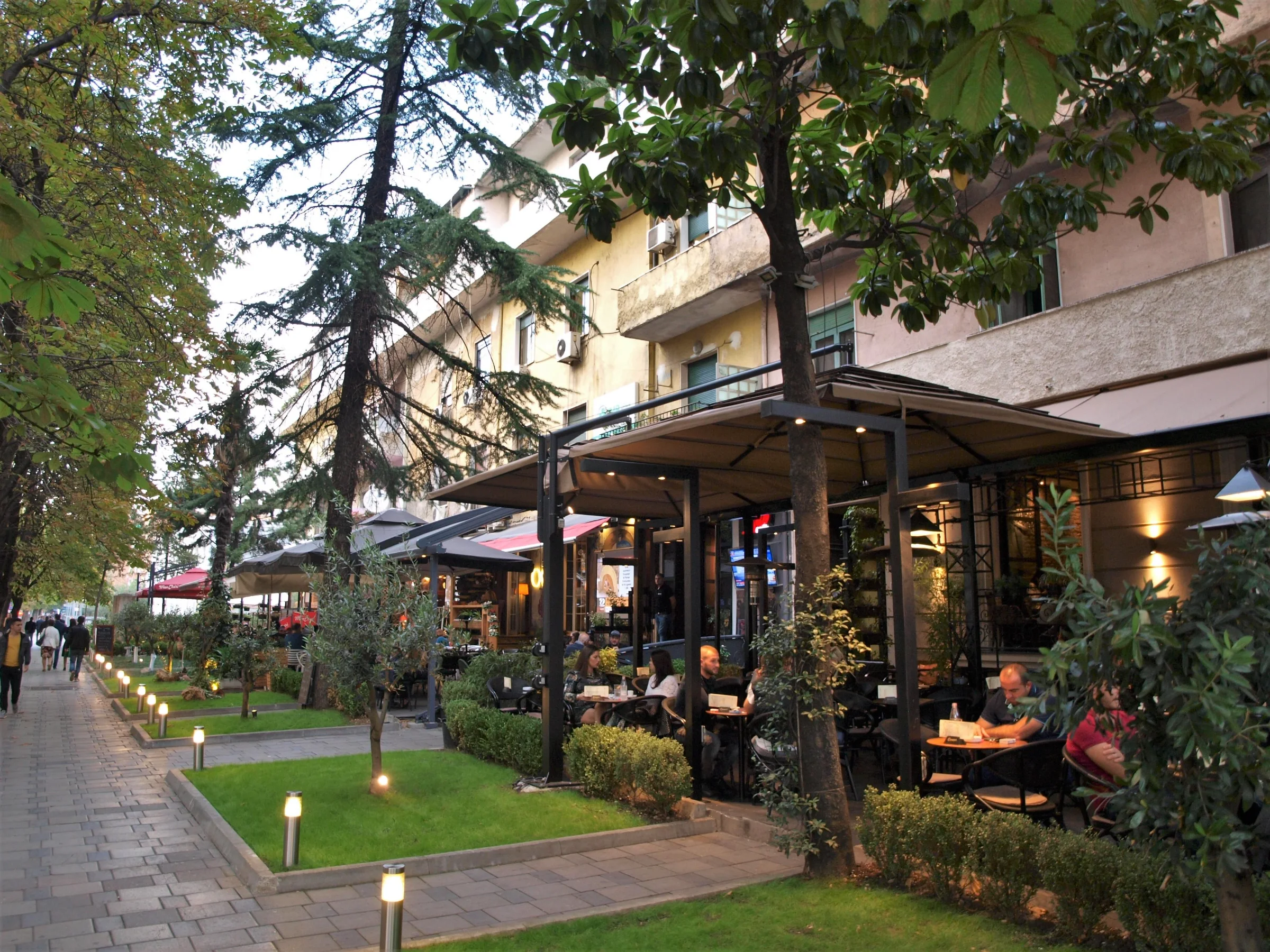
Every table is occupied. The terrace has been claimed. People are dressed for an evening that clearly matters. Music leaks into the street, waiters navigate the narrow spaces between chairs and almost everybody seems aware of who has just arrived.
Then very little happens.
Nobody rushes to order again. Nobody finishes the drink in front of them. Nobody appears anxious to move to the next place.
A group can remain around the same table for several hours while consuming one cocktail each with almost ceremonial restraint.
The drink is not the event.
It is the admission fee for remaining visible.
That is the first thing to understand about Tirana after dark. The city is socially alive on almost any evening. It is not necessarily partying on every evening.
Tirana parties sitting down—until the night gives it a reason to stand up.
A full terrace is not the same as a party
Descriptions of Tirana’s nightlife often confuse four different things:
- a café that remains busy after dark;
- a bar full of people who have no intention of leaving;
- a restaurant that becomes louder as dinner ends;
- and an actual club night where people dance.
These can all exist within several hundred metres of one another, particularly in Blloku, but they are not interchangeable.
A visitor can walk through the neighbourhood on a Tuesday evening and conclude that the entire city is out. That may be true socially. It does not mean that a convincing dance floor will materialise later.
The distinction matters because Tirana often looks further into its night than it actually is.
Tables fill early. People stay late. Coffee remains surprisingly visible. A single cocktail can last longer than some European dinners. The atmosphere builds through occupation rather than turnover.
This creates an unusual rhythm. A bar can be crowded without feeling frantic. A street can be lively without producing much movement. An evening can feel sociable while remaining strangely static.
Do not mistake this for a lack of nightlife.
It is a different definition of nightlife.
Blloku is not a tourist trap. Some of its bars are.
Blloku is one of the most useful nightlife districts in Europe.
That is not because every bar is good.
It is because so many different versions of an evening are compressed into a small, walkable neighbourhood that remains heavily used by Tirana residents themselves.
During Albania’s communist period, the area was reserved for the political elite and closed to ordinary citizens. It now contains the city’s most visible concentration of cafés, restaurants, cocktail bars, lounges and late-night venues.
The transformation is almost too narratively convenient: exclusion became consumption, guarded streets became terraces, and the former home of Enver Hoxha now sits among some of the capital’s most conspicuous public social life.
But Blloku is not a museum lesson after sunset.
It is a working entertainment district.
Locals do not merely tolerate it while tourists photograph cocktails. They occupy it. They dress for it. They return to the same tables and recognise the same people.
The mistake is assuming that local popularity guarantees quality.
Some venues sell little more than upholstery, loud menus and the opportunity to purchase a table in public. The warning signs are familiar:
- the exterior is more carefully designed than the drinks;
- nearly every table is reserved, although nobody seems particularly happy to be there;
- music is loud enough to suggest a club but nobody is dancing;
- service revolves around groups, bottles and visible spending;
- and the room appears to have been designed primarily for photographs taken from one angle.
None of that makes Blloku itself a trap.
It means you need to select the bar rather than merely select the district.
Eat before the table becomes the evening
Tirana’s bar culture can absorb an evening so completely that dinner becomes an administrative problem.
Eat first.
For a smooth start inside Blloku, Çoko Bistro & Bar is useful precisely because it is not pretending to be an undiscovered tavern. It opened in 2011, sits on Rruga Pjetër Bogdani and serves dinner daily from 17:00 until midnight.
Çoko works as a transition rather than a destination performance: a proper meal, a mixed-age local crowd, enough evening energy to avoid feeling like an early sitting and no need to relocate across the city before the first drink.
It also reveals a part of Tirana’s social structure that disappears in some later venues. Different generations remain visible. The evening has not yet narrowed itself into young people, expensive trainers and strategic seating.
This is not the place to search for the cheapest traditional Albanian plate.
It is the place to avoid beginning a cocktail night on an empty stomach.
The practical rule is simple: eat by 21:00 when you are planning to move through several bars. Tirana stays awake longer than many of its kitchens remain interesting.
Radio Bar is the best introduction to the Blloku rhythm
Radio Bar has been operating since 2009 and remains one of the most reliable first stops in Blloku.
Its collection of Albanian radios, televisions, typewriters, posters, furniture and household objects could easily have become a decorative gimmick. Instead, the place has accumulated enough actual life to avoid feeling like a set.
It works in several modes:
- coffee and conversation earlier in the day;
- a relaxed first drink;
- a crowded terrace;
- DJs or a busier scheduled night when one is advertised;
- and, occasionally, a bar so full that arriving without a plan becomes optimistic.
The drinks matter.
Radio uses local spirits without treating them as compulsory folklore. The Kaipiraki combines lime, fig jam and juniper raki. The Rakberry uses blackberry raki, berries, lime and soda. The Tirana Mule uses Albanian gin with ginger beer, citrus and cucumber.
That makes Radio a better introduction to Albanian alcohol than ordering an unexplained shot simply because a guide instructed you to try raki.
Current venue listings checked in July 2026 place most cocktails at approximately 600–800 ALL. That is not the price of a village drink, but it remains reasonable for a carefully made cocktail in one of the capital’s best-known bars.
The listed hours currently run until approximately 01:00 from Monday to Wednesday, 02:00 on Thursday and Friday and later on Saturday. Hours and programming should still be checked before making an evening depend on them.
Radio is not always where the night becomes wild.
It is where the night begins to make sense.
Sit down. Order one drink. Watch how long everybody else keeps theirs.
Nouvelle Vague is where Tirana takes the cocktail seriously
Several minutes away on Rruga Pjetër Bogdani, Nouvelle Vague offers a more deliberate drinking experience.
The bar opened in 2012 and reached number 86 on the extended World’s 50 Best Bars list in 2023. That recognition matters less than what appears in the glass.
The current ORIGIN’AL menu builds cocktails around Albanian ingredients rather than merely giving international classics local names.
Examples include:
- Deviated Negroni, with fortified Kallmet wine and juniper raki;
- Quince, with quince, Albanian honey, lemon and raki;
- Nou Whey, with hazelnut milk, elderflower and pear raki;
- Black Sabah, with Turkish coffee, toasted corn, honey, spices, Muscat raki and rum;
- and Drunk Bee, with bee pollen, apple biscuit and Puls Berati raki.
This is not the place to order whatever is cheapest and leave.
Ask what the bartender recommends. Sit at the bar when possible. Order something that uses a local ingredient for an actual reason.
Current listings show opening from around 18:00 until 02:00 daily, with Sunday beginning slightly later. Recent spending estimates generally place one or two drinks in the 500–1,500 ALL per-person range, depending on the order.
Nouvelle Vague is polished, but not empty polish.
It is also one of the better choices for somebody arriving alone. The bar itself gives you somewhere to sit without requiring a group to justify an entire table.
That matters in a city where the table can dominate the social experience.
<figure> <img src="https://nouvellevaguetirana.com/assets/images/cocktails/gallery10.jpg" alt="The courtyard and evening crowd at Nouvelle Vague in Tirana" loading="lazy"> <figcaption>Nouvelle Vague’s compact courtyard. Official venue image; externally hosted by Nouvelle Vague.</figcaption> </figure>
Where Tirana’s young crowd actually drinks raki
The honest answer is that there is no single youthful raki quarter waiting to be discovered.
Raki exists in several different social worlds.
Where raki is displayed
Komiteti is the obvious accessible introduction. It combines a large selection of raki with an interior crowded by Albanian household objects, furniture and memorabilia.
It is useful.
It is also consciously presented.
Komiteti allows visitors to compare flavours, ask for recommendations and drink raki without walking into an anonymous neighbourhood café where everyone turns to inspect the foreigner who has misunderstood the room.
That makes it a sensible tasting stop, but not proof that young Tirana spends every evening sampling fruit distillates beneath communist antiques.
Where raki is modernised
Radio and Nouvelle Vague show the more contemporary version.
Here, raki becomes part of the cocktail culture used by a young, mixed and visibly urban crowd. It can appear with blackberry, quince, coffee, local honey, mountain tea or indigenous wine.
This may be the most honest answer to where younger Tirana drinks raki publicly.
Not necessarily as a naked shot.
As an ingredient that has been given a new social setting.
Where raki is simply drunk
Basic neighbourhood cafés still exist beyond Blloku and the polished centre.
One named example is Andi Bar, close to Avni Rustemi Square on Rruga Luigj Gurakuqi. Recent visitor reports repeatedly mention inexpensive, generously served raki and a straightforward local atmosphere.
Do not treat it as a secret nightlife destination.
It is closer to the ordinary café-bar end of the city: basic surroundings, simple drinks and a clientele that may be older and more male than the crowd in Blloku.
That is precisely the point.
The grottier café is not necessarily where the young mixed nightlife crowd is hiding. Sometimes it is simply a grottier café where regular customers drink what they have always drunk.
Authenticity does not automatically produce a better evening.
Commercial is not a dirty word
A strange travel-writing rule suggests that a venue becomes more recommendable as soon as it is described as underground, independent or difficult to find.
That is nonsense when the actual objective is to have a party.
Tirana has commercial clubs with recognisable artists, visible production, crowded rooms, dramatic lighting, table service and people who have made an obvious effort to go out. They can be vain, loud and expensive by local standards.
They can also be considerably more fun than paying an entrance fee to discover what “experimental” happens to mean that evening.
The correct question is not whether a club is commercial.
It is whether the commercial machinery produces the night you were promised.
Magic Club: Albanian pop, spectacle and a crowd that came to go out
Magic Club is in Blloku and makes no attempt to present itself as a restrained music space.
The club says it opens five nights a week and publishes a rotating weekly line-up. Recent names on its own site include Finem & Solo, Teuta Selimi, Fatmira Brecani, Ronela Hajati and Mato Lale.
That tells you more than a vague description of the musical atmosphere.
Expect Albanian pop, dance music, guest performers, DJs, strong lighting, tables, bottles and a crowd dressed for a visible night out. This is not where you go to prove that you found the most obscure address in Tirana.
It is where you go when the named performer appeals, the room looks busy and you would rather risk a commercially excessive night than an intellectually approved disappointment.
Reservations matter more here than at a cocktail bar. Check the weekly line-up, contact the venue about entry and table conditions and do not assume that arriving as an unannounced group of men will be treated the same as a mixed group with a booking.
Magic Club is not subtle.
That is useful information, not criticism.
<figure> <img src="https://magicclub.al/wp-content/uploads/2025/03/magic_club_tirana_official__2025-03-10T011234.000Z_2.jpg" alt="A crowded party night inside Magic Club in Tirana" loading="lazy"> <figcaption>Magic Club on a busy night. Official venue image; externally hosted by Magic Club.</figcaption> </figure>
Puls House Club: a central house night with an actual booking
Puls House Club sits on Rruga Pjetër Bogdani in Blloku.
Its usefulness is straightforward: it books recognisable house acts and gives you a central dance option without requiring a journey to the edge of Tirana.
Published 2026 event listings included Belgian DJ Samm on 20 February, Sunnery James & Ryan Marciano on 15 May and Divolly & Markward on 29 May.
That does not guarantee the next night will be good.
It does show that Puls is not merely a generic room using the word house on a poster. Check the current date, the named artist, ticket conditions and the venue’s own social feed. Go when that information gives you a reason.
For a visitor who wants an accessible, recognisable dance night, Puls may be more relevant than a supposedly secret venue whose appeal begins and ends with the word underground.
Escape Premium: leave the centre for the full production
Escape Premium Club is near Tirana East Gate rather than inside the central bar cluster.
That location changes the decision. Escape is not a place to inspect casually between two Blloku drinks. You choose the event, book the ride and make the club the main destination.
Its official event archive includes nights built around performers such as Noizy, Ledri, Ronela Hajati, Xhensila, Don Xhoni and Yll Limani, alongside Greek nights and larger themed shows.
The model is clear: Albanian and regional stars, DJs, stage production, VIP areas, premium bottles and a large crowd expecting a show.
This is commercial nightlife in the most literal sense.
It can also be exactly the right choice when the artist is someone you want to see.
Check whether the club is in season, confirm the current event rather than relying on an old listing and arrange transport both ways. Do not discover at 03:30 that your premium night took place well outside the part of Tirana you can comfortably walk back from.
Tunel is an option, not a moral achievement
Tunel publishes individual electronic events and operates both an indoor venue and the more seasonal Tunel Terrace.
Some of those nights may be excellent.
The label attached to the venue is not enough.
Go because the DJ, event format, location and ticket price make sense—not because a guide has implied that choosing something underground makes you a more serious traveller.
A named programme is useful information.
A subculture adjective is not.
Tables can be the party—or the obstacle
Tirana’s mainstream clubs and lounges are often built around tables, reservations, door selection and bottle service.
That does not automatically mean nobody is having fun.
At Magic or Escape, the table may be part of a larger production: performers on stage, people singing along, servers moving through the room and the crowd reacting to something beyond its own appearance.
At a weak lounge, the furniture is the entire event.
A simple filter helps:
- Is there a named artist, DJ or event?
- Do recent images show people reacting to the stage or actually dancing?
- Are ticket and reservation conditions clear?
- Can the venue explain what is happening that night without using only words such as premium, exclusive or underground?
- Does anybody appear to be having the kind of night you want?
Do not reject a club merely because it is commercial.
Reject it when the commercial promise consists only of paying more to stand beside a table.
Is every night a party?
No.
Almost every evening can feel socially active, especially in Blloku. That is not the same thing.
As a planning rule rather than a law:
Monday to Wednesday
Expect cocktails, coffee, terraces, conversation and people-watching.
Radio and Nouvelle Vague can still work well. Magic Club may have a line-up, but check rather than assuming. A serious dance floor is less dependable unless a specific event says otherwise.
Thursday
Thursday is the first evening on which the city more reliably begins to move beyond the table.
Bars become fuller, club programmes become more likely and the distinction between a drink and a night out begins to narrow.
Friday and Saturday
These are the safest choices for combining Blloku with a real party.
Check Magic for Albanian pop and guest performers, Puls for a house booking, Escape for a large event outside the centre and Tunel when the line-up itself is convincing.
These are also the nights on which reservations, door policies, full terraces and crowded rides home become more relevant.
Sunday
Sunday can remain visibly sociable while offering fewer convincing late options.
Choose the venue, not the neighbourhood.
A walk through Blloku may still look lively. Your preferred club may still not be doing anything worth entering.
Can a woman go out alone in Tirana?
Yes.
That answer does not require adding “but perhaps choose a quiet wine bar”.
A woman alone can reasonably go for a cocktail at Radio or Nouvelle Vague and attend a properly advertised night at Puls, Magic Club, Tunel or another mainstream venue.
The practical difficulties are often social rather than immediately dangerous.
Many Tirana venues are designed around groups and tables. A solo visitor can therefore feel conspicuous even when nobody is behaving threateningly.
For the first drink, choose a bar with an actual counter and arrive before every seat is claimed. Tell the bartender you are alone rather than waiting for the room to solve the problem invisibly.
For clubbing, a named event is easier to assess than a lounge that sells only atmosphere. Magic and Escape are highly social, table-heavy rooms; Puls and some electronic events may offer a clearer reason to be there without a group, depending on the night.
Escape requires extra planning because of its location near TEG. Book the journey rather than relying on the possibility of finding transport after the event.
Albania’s current UK travel advice says that crime targeting foreigners is rare, while still recommending normal precautions against street crime in larger cities and late at night.
That is the correct level of reassurance.
Tirana is not a city where a woman should expect to be confined to her hotel after dinner. It is also not a city where normal drink safety, situational awareness and a sensible journey home become unnecessary.
Staring and unwanted attention should not be renamed hospitality. A crowded central street is preferable to an empty shortcut. After a late club, use a booked ride rather than turning a long walk through unfamiliar side streets into a test of principle.
A woman can go out alone.
She should not have to pretend that being alone makes every venue equally well designed for her.
What a good Tirana night actually looks like
There is no single correct route.
There are at least three usable versions.
The first Blloku night
Eat at Çoko.
Begin at Radio with a raki-based cocktail.
Move to Nouvelle Vague for one drink that requires more attention.
Then walk. Blloku is compact enough to inspect the crowd, the music and the amount of actual movement before committing to another venue.
Stop there if the tables remain more interesting than the prospect of forcing a club night.
The unapologetically commercial night
Check the current Magic Club line-up.
When the performer appeals, reserve or clarify entry conditions and let the club be as excessive as it intends to be.
Choose Escape instead when its advertised artist or themed night justifies the ride to TEG and back.
Commercial does not mean fake.
It means the venue has made a clear promise and expects you to pay for it. Judge whether it delivers.
The house night
Check Puls, Tunel and any current one-off event before dinner.
Choose the named booking first.
Use Blloku for the opening drink, then go where the actual dance floor is advertised rather than expecting the district to manufacture one automatically.