

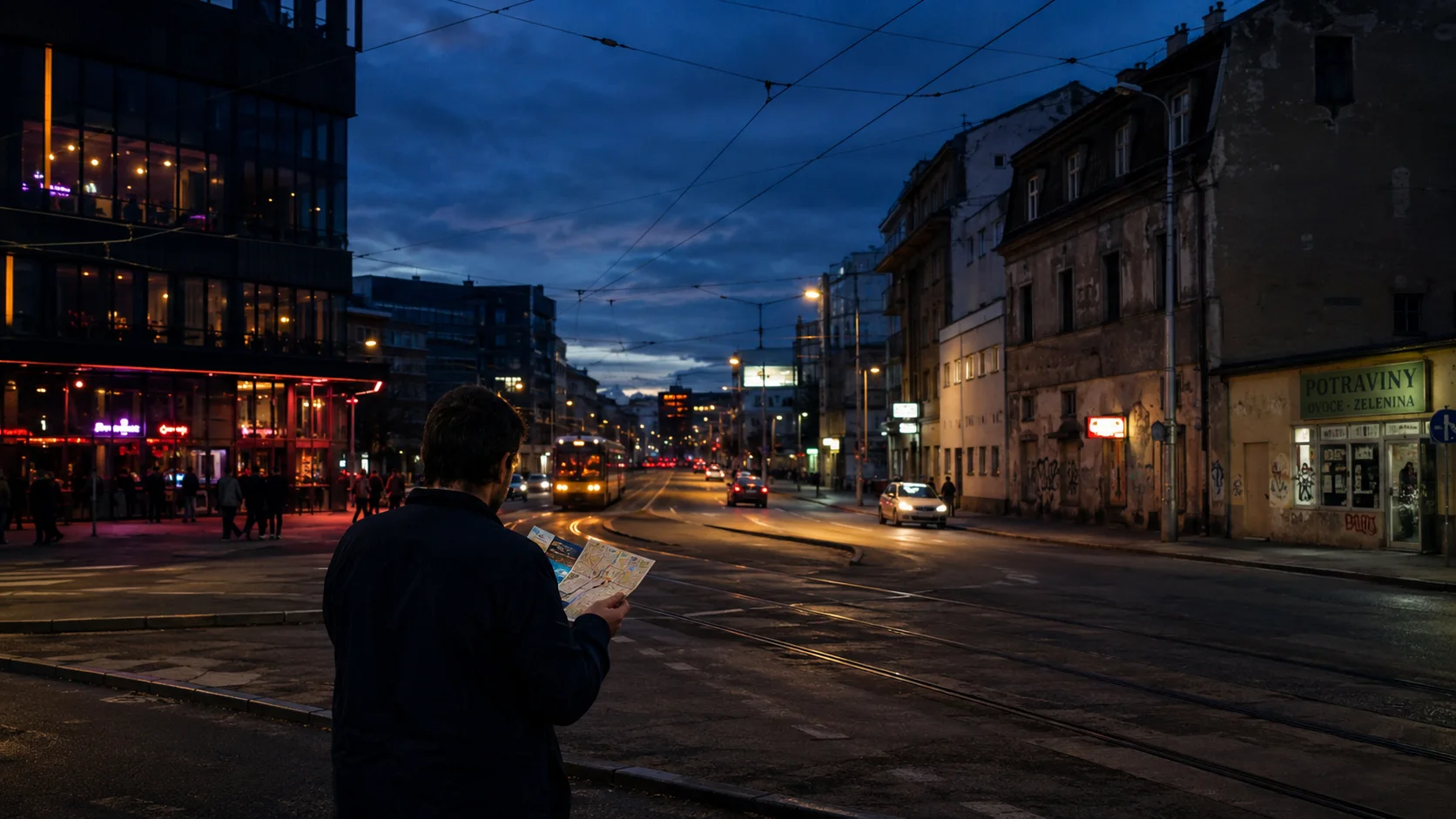
A travel guide should tell you what kind of trip you are choosing, including the parts that will not suit everyone.
I wanted a night out in Ostrava.
Online, that looked easy.
The internet was full of confident suggestions: lively streets, distinctive bars, alternative venues, clubs, late-night food and enough reassuring adjectives to make the city sound almost impossible to get wrong after dark.
Then I arrived.
Some recommendations felt outdated. Others existed but did not resemble the experience being advertised. Places that supposedly defined the city’s nightlife were quiet, closed or difficult to judge from the outside. Lists repeated the same names without explaining what kind of evening they actually offered—or whether they still offered much of anything.
By that point, the polished guides had stopped being useful. I found myself relying almost entirely on ChatGPT to work through what was nearby, what might still be open, where the atmosphere had moved and which option made sense next.
I did not need another list of nightlife venues.
I needed someone—or something—to help interpret the city as it actually existed that evening.
That sounds like a simple request. Online, it often produces an impressive amount of information and surprisingly little help.
The problem is not a lack of travel content
There has never been more travel information available.
Search for almost any city and you will find destination pages, hotel round-ups, neighbourhood explainers, short-form videos, map lists, forum discussions, AI itineraries and several hundred people promising to reveal places that apparently remain hidden despite appearing in every search result.
Some of it is useful. Much of it is technically correct.
The problem is that correctness alone does not make a guide useful.
A list can correctly identify ten attractions without explaining whether they belong in the same trip. A hotel article can contain accurate addresses while avoiding the more important question of whether those streets become noisy, empty or inconvenient after dark. A nightlife guide can name every supposedly essential venue in a city and still fail someone standing there on a quiet evening, trying to work out where people actually go.
More information does not automatically reduce uncertainty. Sometimes it simply gives uncertainty more tabs.
A list is not a point of view
There is nothing inherently wrong with a list.
Sometimes you genuinely need opening hours, transport options or five hotels in the right district. The old argument between “authentic storytelling” and “practical travel information” is mostly artificial. A good guide should be capable of both.
The problem begins when the format replaces the judgement.
Twenty recommendations are not more useful than five when nobody explains why any of them belong there. Calling each one “unmissable”, “vibrant” or “perfect for every traveller” does not solve that problem. It merely ensures that no meaningful choice has been made.
A guide should be willing to say:
- this city works better as a relaxed weekend than as a packed cultural itinerary;
- this neighbourhood is convenient during the day but irritating at night;
- this famous attraction is worth seeing, although the surrounding experience is not;
- this road is beautiful but slow enough to change the rest of your route;
- this destination may be cheaper than the obvious alternative, but that is not the main reason to choose it;
- and this place is good, but probably not for you.
That last sentence matters.
If every destination is suitable for everyone, the guide is not describing destinations. It is distributing approval.
The better guides have always had a reason to exist
The strongest travel publications are not interchangeable.
Lonely Planet became useful because it organised large amounts of practical information for independent travellers. Rough Guides built its reputation around candid, culturally informed guidance rather than polished resort copy.
The New York Times’ 36 Hours uses a strict time limit to turn a city into an actual itinerary. Atlas Obscura looks at the world through curiosity, collecting places that conventional guides often overlook. Roads & Kingdoms uses food, local reporting and human stories as a way into destinations rather than treating meals as another booking category.
These formats do not work because they discovered a magical alternative to travel writing.
They work because each of them answers a different question.
A Lonely Planet guide, an Atlas Obscura entry and a Roads & Kingdoms story may all cover the same city, but they should not produce the same experience. Their editorial lens changes what gets included, what gets omitted and what the reader is expected to do with the information.
That distinction disappears when publishers copy only the visible surface: a large photograph, an enthusiastic introduction, a map and a numbered list.
The result looks like a guide. It simply has no particular reason to exist.
The unlikely book that stayed with me
My own interest in travel guides that feel genuinely different did not begin with a beautifully designed city magazine.
It began, somewhat less elegantly, with Robert Young Pelton’s Fielding’s The World’s Most Dangerous Places.
This is not a suggestion that InstantTraveling should become a guide to war zones, kidnapping risks or places where a misunderstanding at a roadblock can permanently alter the itinerary.
It should not.
The influence is not the danger. It is the commitment.
The book was informative, immersive, specific and frequently uncomfortable. It combined history, risk, logistics, first-hand experience and a darkly practical sense of humour. It did not pretend that every destination could be reduced to a pleasant weekend with several photogenic cafés.
Most importantly, it had a clear reason to exist.
You could disagree with its perspective. You could question the appetite for danger behind it. You certainly did not have to use it as a holiday planner.
But you could not mistake it for another generic travel guide.
That difference stayed with me.
A useful guide explains the decision
InstantTraveling is not being built to compete on volume.
There will always be a larger website, a faster publishing operation and an algorithm capable of producing more articles about “things to do”. Trying to win that race would create exactly the kind of site this project is meant to avoid.
The aim is to make each format answer a recognisable question.
The destination guides should explain atmosphere, trade-offs, transport, useful areas to stay and what the destination is actually good for.
The comparisons should help with the decision that happens before the booking. Not “both cities are wonderful”, but which city makes sense for this trip, this amount of time and this traveller.
The After dark pages should cover the part often missing from conventional city guides: what changes when the sightseeing stops, which areas remain useful, how the atmosphere shifts and whether returning to the hotel becomes needlessly complicated.
The road and route guides should treat the road as part of the trip. Road quality, detours, border friction, fuel, accommodation rhythm and the question of whether a car is genuinely useful all belong before the rental link.
The field notes should make room for observations, arguments and useful travel ideas that do not fit neatly inside a destination card.
This does not mean every article must be severe, contrarian or exhaustingly comprehensive.
Some can be light. Some can begin with a strange roadside stop, a bad hotel decision or an evening that became more memorable than the planned itinerary. Travel is allowed to be funny. It frequently is, especially once transport is involved.
But the tone and the judgement must remain recognisable.
Practical does not mean lifeless
There is a tendency to separate travel content into two weak extremes.
At one end is the brochure: everything is inspiring, effortless and suitable for everyone.
At the other is performative anti-tourism: the writer is supposedly too interesting for famous places, normal hotels, guidebooks, queues or anyone carrying a suitcase with wheels.
Neither is especially helpful.
A traveller can want a comfortable hotel and still care about where the neighbourhood changes. Someone can visit the famous square and also want to know whether the streets behind it are worth another evening. A road trip can include a carefully chosen restaurant without becoming a luxury lifestyle production.
“Unpolished” does not mean deliberately uncomfortable. It means that the inconvenient parts are not edited out simply because they disrupt the sales pitch.
That principle also applies to commercial links.
A booking tool belongs in a guide when the guide has first helped the reader understand what to book. A hotel search becomes useful after the article explains the relevant areas. Car hire belongs after the route establishes that public transport will not do the job.
The link should follow the editorial reasoning—not replace it.
InstantTraveling is still under redevelopment
At the time of writing, InstantTraveling is still being redeveloped.
Some sections are establishing their final structure. The first published guides are also tests of the format, visual language and connections between destination context, comparisons, evening reality and practical planning.
That is not hidden because there is little value in pretending a publication appeared fully formed overnight.
The editorial principle, however, does not need to wait until every tool, destination and partner integration is finished. In fact, it should be visible before the archive becomes large enough to obscure it.
The related Vayluna article looks at the same broader issue from the perspective of building and directing digital platforms:
Read the related article on Vayluna
Publishing this now creates a standard against which the next articles can be judged.
Not merely: is the information correct?
Also:
- Is the topic worth covering?
- Is the angle recognisably ours?
- Does the article help with a real choice?
- Is the practical information connected to that choice?
- Could this text appear unchanged on fifty other travel websites?
If the answer to the last question is yes, it is not ready.
Better guides, not louder ones
InstantTraveling will not make travel uncomplicated.
Cities are inconsistent. Restaurants close. Roads deteriorate. Areas change character between Tuesday afternoon and Saturday night. Prices move, transport fails and sometimes the supposedly atmospheric hotel room is directly above the atmospheric bar.
A guide cannot remove those variables.
It can make them visible.
That is the real job: not to tell readers that every place is wonderful, but to show them what kind of experience they are choosing and what may come with it.
We do not need another article announcing that Brussels has beer, Kraków has a beautiful square or a coastal road has good views.
We need guides that notice what happens around those obvious facts.
We need better ones.